
Two perspectives: Pierre Béal answers Malika Ait El Mouden’s questions on technology, the environment and systemic transformation. An unfiltered exchange, as lucid as it is authentic.
1- You have worked at the intersection of science, technology and environmental issues… ahead of your time! When did you realize that the transformations under way were not just technical, but deeply systemic?
In 2000, I did indeed start a company, NUMTECH, at the intersection of digital and the environment. On paper, the idea seemed obvious. In practice, I was ahead of a world that was not yet ready to hear that message.
It was in Africa that everything changed. In the field, far from the rhetoric and the results of our simulations, I saw something that theoretical models do not capture: environmental transformation is not a technical problem. It is a problem of how we represent the world, of power relations, of access to information, of trust. I saw communities already living with the consequences of disruptions that we were still debating in Europe as future hypotheses. And I understood that the digital tools we were developing were not only optimization tools: they could be tools for awareness, for storytelling, for mobilization.
But this conviction ran into a wall: neither investors, nor institutions, nor even the business world were ready to see the link. Digital was the domain of growth. The environment was the domain of constraints. The idea that they formed one and the same system, that one could not be transformed without the other, was at the time something almost no one was willing to hear. That is when I understood that the real transformation was not technical. It was systemic: it involved mental models, organizational structures, collective narratives. And that those who refused to see it would inevitably fall behind.
Twenty-five years later, what seemed marginal has become central. It is a condition for the survival and relevance of any organization that wants to play a role in the world ahead.
2- With hindsight, what can technology really transform in the face of environmental challenges… and what can’t it solve?
It allows us to know. Never in human history have we had access to such precision about the state of our planet: climate modeling, IoT sensors measuring air quality in real time, satellites mapping deforestation hectare by hectare, algorithms cross-referencing data that the human eye could never connect alone. What we once had only a vague sense of, technology makes visible, measurable, undeniable. It turns intuition into proof.
It then allows us to connect. One of the most underestimated contributions of digital is its ability to reveal interdependencies: how the disappearance of a forest in the Amazon affects rainfall in Europe, how the supply chain of an ordinary product generates invisible emissions on the other side of the world. These links existed before. Technology makes them legible, and therefore actionable.
Finally, it allows us to visualize. And that is perhaps its deepest power. A number such as “1.5°C of additional warming” remains abstract for most people. An immersive simulation showing what happens to the Bordeaux coastline, a flood map of Dhaka or the evolution of biodiversity in an Alpine forest by 2050: that is what hits home. Technology can make the future perceptible, and this is a necessary condition for individuals and organizations to start acting.
However, it cannot replace willpower. Recent history is full of telling examples: we have had data on global warming since the 1970s. We have had the models, the IPCC reports, the repeated warnings from scientists. The knowledge was there, massive and documented. And yet. It was not algorithms that held back action: it was the resistance of economic interests, the short time horizon of political cycles, and sometimes simply the human difficulty of acting on what people do not yet feel in their daily lives.
Technology does not replace political courage. It does not replace changing economic models. It does not replace the capacity of societies to look beyond the next quarter or the next election. It lights the way. But it is women and men who decide whether or not to walk it.
And that is precisely why the systemic transformation we need will not happen in laboratories. It will happen in boardrooms, legislatures, classrooms and in people’s minds.

Al Gore speaking at the United Nations Conference on Environment and Development in Rio de Janeiro (Brazil)
3- Have you seen a proliferation of environmental tools, data and indicators? Has this abundance really improved the quality of decisions? Or has it shifted the problem elsewhere?
I experienced this abundance firsthand. I saw models go from kilometer scale to meter scale, then to centimeter scale. I saw sensors get smaller, multiply, connect. I saw dashboards fill up with ever finer indicators, reports grow thicker, databases grow heavier. A fascinating technological rush forward and, I must say, a sometimes intoxicating one. But very early on, I made a different choice. Deliberately different.
When I started my company in 2000, I quickly came to see that the central problem was not a lack of data: reliable data already existed. The problem was that nobody understood it, nobody felt it, nobody translated it into a story accessible to as many people as possible. While massive investment went into refining knowledge, the question of passing it on remained wide open. So I deliberately steered the company’s development toward communication, visualization and teaching: convincing people to act on what we already knew, rather than waiting to know even better.
This race for precision has, to a large extent, masked inaction. It offered a kind of collective clear conscience: we measured better, so we felt we were making progress. Companies published ever more sophisticated reports. Governments set up observatories, indicators, national dashboards. And all the while, global emissions kept rising.
The abundance of tools shifted the problem: it intellectualized it, made it technical, sometimes deliberately complicated it to delay the operational consequences. Measuring became an end in itself, when it was only a means. This is not an indictment of technology. It is an indictment of how we have used it: we confused the map with the territory, and the indicator with action.
The real question was never “are we measuring well enough?” It has always been “what do we do with what we know?” And to that question, no sensor, however precise, can answer for us.
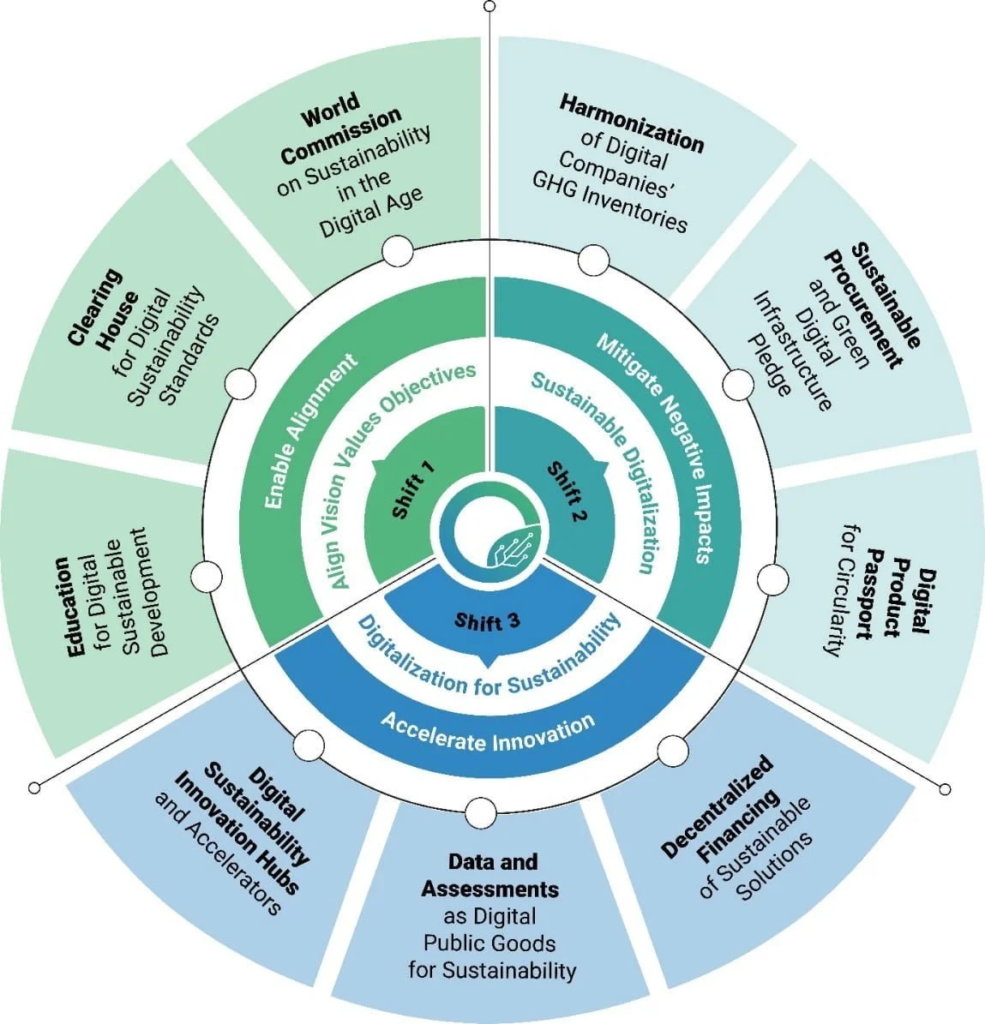
Source: Data for Climate Change. Umwelt Bundesamt
4- In your career, have you faced situations where measured reality contradicted dominant narratives or vested interests? How do you handle that kind of tension?
In my career, the contradiction between measured reality and dominant narratives was not the exception. It was the rule. Almost every study, every diagnosis, every piece of data we produced challenged either an operator’s view of their site, or a local authority’s interests, or the economic balance of players who had no wish for reality to be what our tools revealed.
And the reaction was always the same, with an almost disconcerting predictability: they attacked the tool.
Our software was too complex. Our sensors were unreliable. Our methodology was debatable. Our sampling was insufficient. We were met with commissioned counter-expertise, in-house experts, technical arguments meant not to refine knowledge but to neutralize it.
What was striking, and at times frustrating to the point of absurdity, was that our conclusions were often nothing esoteric. They were common sense. What our tools confirmed, an attentive observer could have seen with the naked eye or through simple reasoning. But common sense becomes unwelcome when it has consequences. Our position was uncomfortable. We were not decision-makers. We produced a truth that others had the power to ignore, contest or bury. And the risk was twofold: either give in to pressure and water down the conclusions, which would have betrayed our mission, or stay the course and lose the contract, or even the relationship.
I learned several things from this experience:
The first: rigor is the only armor. Once our protocols were beyond reproach, once our data were traceable and our methodology transparent, the attacks slid off. They could contest our conclusions, but they could not contest our professionalism.
The second: you have to know who you are really talking to. In many of these situations, the immediate counterpart (the site manager, the local elected official) was not the only player involved. Widening the circle, bringing in other stakeholders, making results public or shareable: that was often the only way to give them a real chance.
The third, perhaps the most important: the data that unsettles people today becomes tomorrow’s common sense. So many of the results we produced, fiercely contested at the time, were eventually recognized, sometimes years later! This long time horizon is both the source of frustration and the source of conviction. It demands a kind of strategic patience that I personally call the perseverance of facts.
Carrying an uncomfortable truth in a system that is not ready to hear it is a difficult position. But with hindsight, it is also the one that gives the most meaning to a career.
5- There is growing talk (though not much in France) of a “dual transition” or “twin transformation.” In your view, what is the main misconception about this idea today?
The term itself betrays the confusion. “Twin” suggests two of a kind: parallel, symmetrical. Two distinct processes run side by side, coordinated, “reconciled.” That is how most organizations approach it: a digital roadmap on one side, a CSR roadmap on the other, and in the middle, management teams trying to make sure the two don’t contradict each other too much.
That is not transformation. It is portfolio management.
That is where the real misunderstanding lies: twin transformation is not the sum of two parallel transitions. It is one and the same systemic shift, affecting business models, power structures, human behavior and collective narratives all at once. Separating the two is precisely what keeps us from making real progress on either.
And France illustrates this trap perfectly. While the digital transition is largely led by the private sector, driven by innovation and competitiveness, the green transition requires a strong political and societal push: two rationales that don’t naturally speak to each other, two timeframes that ignore each other, two ecosystems of players who rarely cross paths. The result: we make progress on both, separately, slowly, without ever creating the synergies that would give the whole effort its real strength.
There is a second misunderstanding, deeper still, that I have lived with since the beginning of my career: we confused the digital transition with a transition toward more technology, and the environmental transition with a transition toward a smaller footprint. Both are true, but neither is enough. What we missed is the essential point: digital technology can itself be a major source of environmental impact. In 2022, digital technology accounted for 4.4% of France’s annual carbon footprint and 11% of its electricity consumption, and without action, these emissions could rise by more than 45% by 2030. In other words, pointed in the wrong direction, digital technology worsens the very problem it could help solve.
Digital technologies can be seen as a “double-edged sword” in climate transition efforts: they can catalyze the environmental transition, or thwart it. It all depends on the choices that guide their deployment. And those choices are not technical. They are political, economic and cultural.
This is precisely why, back in 2000, I made a choice that many saw as going against the grain: not to chase technological precision (heavier models, hence greater computing power; I gave a talk along those lines in 2004 at TERATEC, the forum of the high-performance computing community), but to invest in the ability to communicate, to make things accessible, to make people want to act on what we already knew. Because I had realized that the bottleneck was not in the data: it was in people’s minds.
Twenty-five years later, the misunderstanding persists. We keep investing massively in ever more powerful, ever more precise, ever more resource-hungry tools, hoping that technology will eventually solve what only human will can transform.
Twin transformation will only become real the day we stop treating it as an engineering problem and approach it as what it truly is: a civilizational problem.
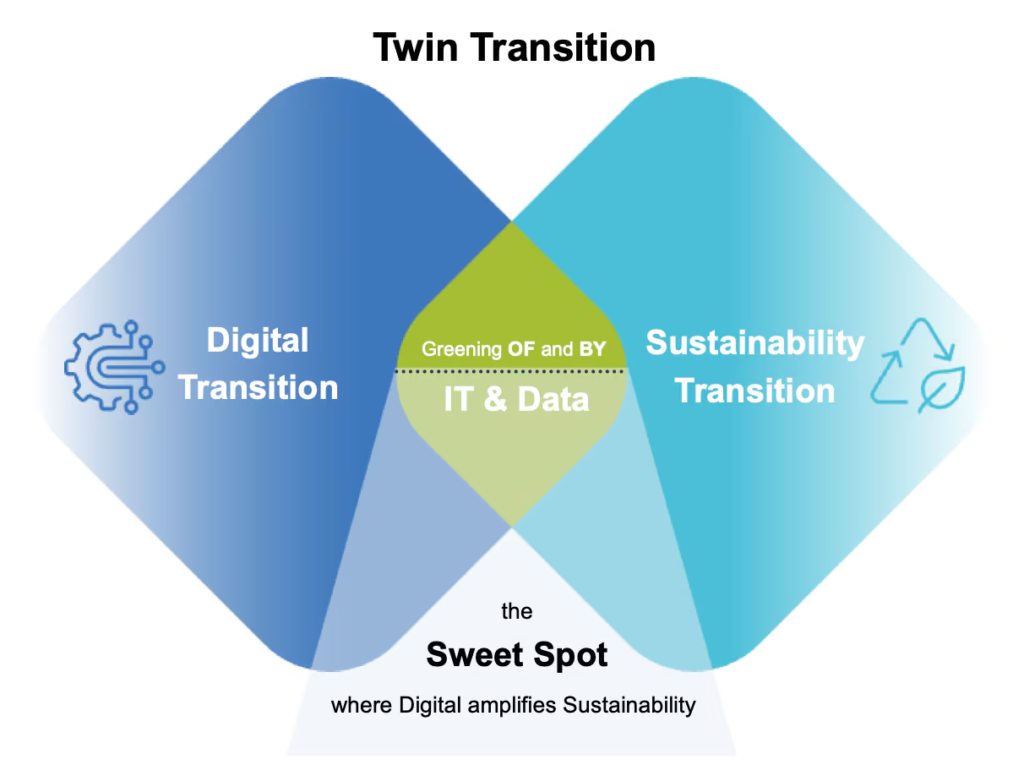
Source: The World Economic Forum

Pierre Béal explores the deep links between technology, the environment and the transformation of systems. A doctor in applied mathematics and an entrepreneur, he has worked for more than 25 years at the intersection of science, data and environmental issues, with a strong conviction: the transformations under way are above all systemic. Founder of Numtech, a pioneering company in environmental modeling, he has helped make visible and actionable realities that long remained abstract. Now Sustainability Director, he supports organizations along their transformation paths, combining climate challenges, business models and strategic decisions. Through his public speaking, he defends a demanding reading of ongoing changes, in which technology is not enough, and in which the real tipping points play out in models, decisions and collective representations.