Where to open warehouses, which plant should serve which market, which truck should deliver to which customer. These questions look different, but they share one trait. The possible answers are far more numerous than any team can review, and each one must respect rules that are not up for negotiation.
Ask a language model where to build your next warehouse and you will get an answer. It will be well written, it will come with a coherent justification, and it may well be wrong. In a draft letter, a mistake is harmless and gets fixed in passing. In a logistics network decision, which commits several million euros for ten years or so, it is not so easy to undo.
Plausible is not reliable
What makes this tricky is not so much the mistake itself as its appearance. The wrong answer looks exactly like the right one. It has the same tone, the same confidence, the same polished presentation.
That is, at bottom, both the strength and the limit of generative AI: it produces what is plausible. For a letter, plausible is enough. For a decision that commits the company, more is needed, namely an answer that is known to respect the constraints and that can be checked. Plausible is not reliable, and the whole question is how to get from one to the other.
Complex decisions with too many options
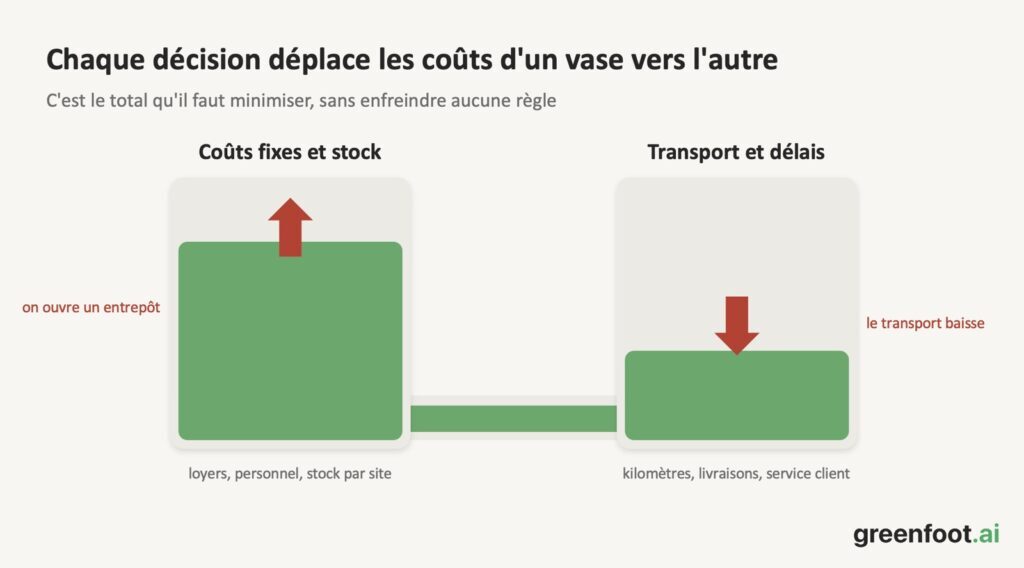
Opening one more warehouse costs rent and inventory, but brings customers closer and cuts transport. Closing one does the opposite, at the risk of saturating the remaining sites and degrading lead times. Each decision shifts costs from one pocket to another, like communicating vessels, and it is the whole that must be considered. That is what an optimization problem is: finding the combination with the lowest total cost, without breaking any rule.
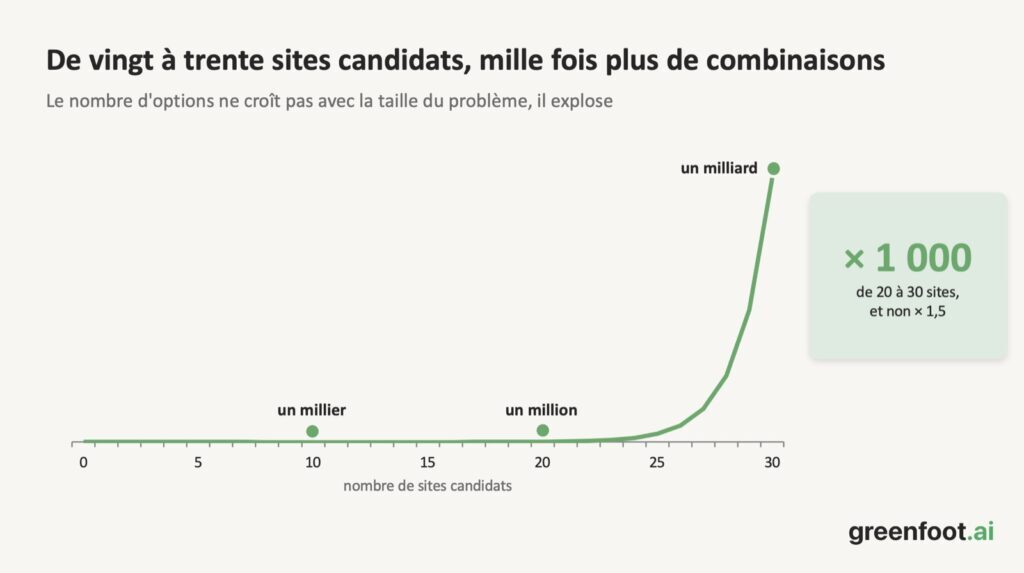
Take twenty candidate sites for new warehouses. Choosing which ones to open already represents more than a million combinations. Add the size of each site, the assignment of customers, capacity limits and expected service levels, and no spreadsheet can cope. Nor does the problem grow politely. Going from twenty to thirty candidates does not multiply the options by one and a half, but by a thousand. This is known as combinatorial explosion.
Complex decisions are not a matter of taste
Operations research has been solving exactly this kind of problem for decades, most often through mixed-integer linear programming, known by its acronym MILP. A MILP solver does not try combinations one by one. It relies on algorithms that let it rule out entire regions of the solution space without exploring them, and it ends with a solution whose optimality is proven, or with proof that no solution satisfies all the constraints.
A language model does not work this way. It does not search, it proves nothing and it rules nothing out. It produces the most probable sequence of words that could answer the question. Asked twice, the same question can yield two different allocations of volumes, with nothing to indicate which one deserves trust.
This is, incidentally, what sets optimization apart from other uses of generative AI. Whereas the quality of a summary is a matter of taste, a decision under constraints is either optimal or not, and sometimes infeasible.
LLMs cannot say no
The answer lies neither in a better prompt nor in waiting for the next model release, but in an architecture where each part plays its role. The language model formalizes. It understands the business question, cleans the data, spots inconsistencies between sources, turns business rules into constraints, then explains the result. It never computes the solution.
The solver decides. With the same inputs, it returns the same result every time, proven optimal or proven infeasible. It does exactly what it is asked, no more and no less.
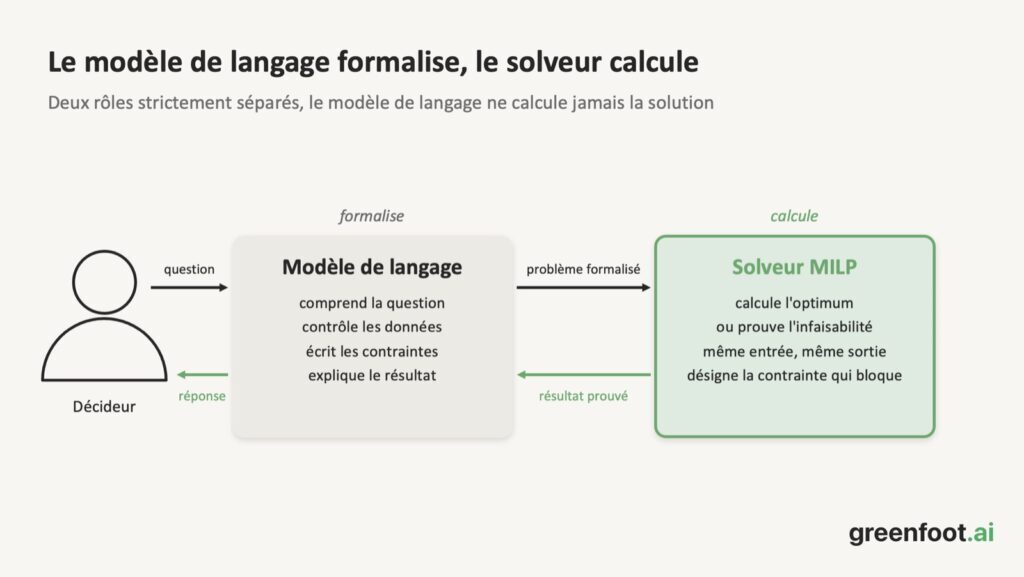
The consequence is a system that knows how to say no, and why. Ask a language model to deliver every customer within twenty-four hours from three warehouses that do not have the capacity, and it will still provide a plan, because it is built to be helpful. A solver will answer that the problem is infeasible and point to the constraint that blocks it.
What LLMs bring, and why it is new
Demand in Spain grows by 30% next year: what does the network look like? We close Lyon: where do its volumes go? New tariffs hit imports from China: what would sourcing from Turkey look like? The model rephrases the hypothesis, the solver recomputes, and the answer arrives within minutes, optimal and compliant with every rule.
If this mathematics is fifty years old and so few companies use it, it is because the cost was never in the computation but in the formulation, the specialist work of translating a real operation into constraints, which becomes obsolete as soon as the operation changes. This is the cost that the language model brings down, in supply chain as in production scheduling, vehicle routing or portfolio allocation.
Would you hand the decision to a black box?
Today’s chatbots, ChatGPT or Claude, are no longer mere language models. They are agents equipped with tools, and if you submit the twenty-warehouse problem to them, they write an optimization program themselves, run it and return the result. The computation is delegated, which confirms the principle.
One question remains, the one an executive asks before any other. What does this number rest on? An investment committee does not approve closing a site on the strength of a figure that appeared in a chat window. It wants to know which data was used, which rules were applied, which options were discarded and why, and it wants to be able to rerun the calculation six months later and get the same result. In a chat, however, data comes in unchecked, the mathematical model is rewritten at every session, and none of it is kept.
This traceability is what separates an answer from a decision. It requires a fixed, tested model, business-specific consistency checks, and a full record of every result. Greenfoot.ai is built on this principle, for a single problem: supply chain network design.
A language model will always give an answer. Only operations research can tell whether it is the right one, or whether one exists.

Fayçal Ziraoui explores how mathematics, artificial intelligence and operations research can transform decision-making in companies. A graduate of École polytechnique and HEC, he has more than fifteen years of experience in strategy consulting and operations transformation, with expertise in supply chain and the optimization of logistics networks.
An entrepreneur and writer, author of L’Affaire du Zodiac (Robert Laffont, 2022, adapted into a documentary series on Canal+), he is interested in complex problems and the methods for solving them.
He is the founder of Greenfoot.ai, a solution that combines generative AI agents with mathematical solvers to make supply chain network design more accessible, reliable and transparent.