

An internationally renowned astrophysicist, Jean-Pierre Luminet sheds light on the big questions of contemporary cosmology: black holes, flambéed stellar pancakes, extreme structures, deep time and the limits of knowledge.
Contemporary cosmology, extreme structures and humanist lessons.
I had the opportunity to join the APM (Association Progrès du Management) for an exceptionally dense day of reflection devoted to the latest advances in cosmology, alongside an international expert whose scientific stature and humanist depth leave a lasting impression: Jean-Pierre Luminet.
An internationally renowned astrophysicist, emeritus research director at the CNRS, and a recognized specialist in black holes and the large-scale structure of the Universe, Jean-Pierre Luminet does more than produce scientific knowledge. He works at the frontiers of the thinkable, where ordinary conceptual frameworks crack, where human intuition falls short, and where science must invent new ways of seeing, modeling and understanding.
The day’s title, “Latest News from the Universe ”, was no gimmick. On the contrary, it signaled a clear ambition: to offer access to the very latest state of cosmological knowledge, at its most rigorous, but also at its most unsettling.
A cosmology in motion: understanding a fundamentally unfinished Universe
One of the first lessons of the day comes down to this observation: contemporary cosmology is neither fixed nor settled. Contrary to a still widely held view, we do not have a definitive account of the Universe. Instead, we work with provisional models, constantly revised in light of new observations and new theoretical hypotheses.
Jean-Pierre Luminet walked us through the major conceptual architectures that shape our understanding of the cosmos today: the Big Bang as the initial expansion phase of space-time; the different scenarios for the fate of the Universe, such as the Big Freeze, the Big Crunch, cyclic models and hypotheses of a cosmic bounce, which remain open and debated; and the central but still largely mysterious role of dark matter and dark energy, which make up most of the Universe’s energy content while eluding direct understanding.
This overview highlights an essential epistemological reality: we understand a tiny part of the Universe with great precision, and the bulk of it very imperfectly. This asymmetry between knowledge and ignorance is not a failure; it is the very engine of scientific research.
Galaxies, flambéed stellar pancakes, supernovae and emergent complexity
The exploration continued with the study of galaxies, not as isolated entities, but as components of a highly structured cosmic system, organized into networks of filaments, voids and clusters, often referred to as the cosmic web.
Jean-Pierre Luminet showed how these structures emerge from “relatively simple” physical processes (gravitation, fluid dynamics, thermodynamics) yet produce, through nonlinear interactions, a dizzying organizational complexity. Stellar and extrasolar systems, far from being local exceptions, fit squarely within these large-scale dynamics.
This was the context for a discussion of some particularly spectacular phenomena, such as flambéed stellar pancakes: flattened structures of matter arising from anisotropic gravitational collapse (a collapse of matter under gravity that does not occur uniformly in all directions), subjected to shock waves, intense radiative flows and extreme thermodynamic processes. These regions embody an unstable, transient but decisive phase in which matter is compressed, heats up and ignites, before reorganizing or fragmenting.
These objects illustrate a fundamental property of the Universe: cosmic order does not emerge from equilibrium, but from instability. Structure is born of turbulence, and form results from successive imbalances. Structure does not preexist; it emerges from turbulence. This raises a question: on the cosmic scale as on the earthly one, could uncertainty be not an anomaly to be corrected, but the very condition of every civilization, organization and society?
Black holes: limit-objects and the failure of human intuition
The heart of Jean-Pierre Luminet’s work remains the study of black holes, which he approaches not as spectacular curiosities, but as limit-objects in the strong sense, that is, regions where our fundamental categories no longer hold.
Near a black hole, time no longer flows uniformly, space is no longer Euclidean, and light itself is trapped by the curvature of space-time. These phenomena are not merely hard to imagine; they are structurally counterintuitive for a human brain shaped by low-speed, low-gravity experience.
Jean-Pierre Luminet is very clear on this point: science progresses here not through intuition, but through mathematical formalization, modeling and simulation. As early as 1979, he was one of the first to produce realistic representations of black holes, not to make them spectacular, but to make perceptible what would otherwise remain abstract.
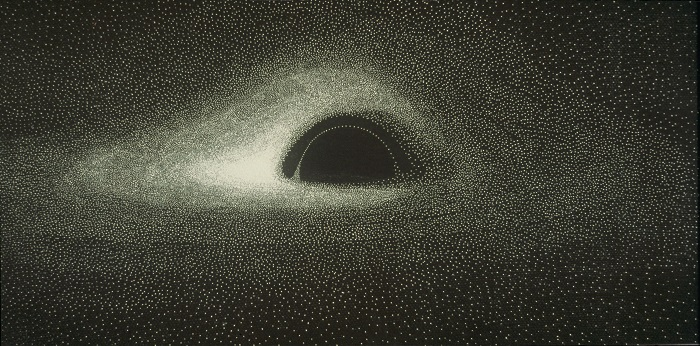
Simulation of a black hole published in 1979 © Jean-Pierre Luminet/CNRS Photothèque
What truly sets Jean-Pierre Luminet’s approach apart is the intellectual stance he embodies. Far from any triumphalist view of science, he reminds us with humility and pragmatism that every advance opens new fields of ignorance, and that every theory is by nature revisable. Contemporary cosmology is a powerful science, but an incomplete one. It advances through successive adjustments, debates and challenges (take Georges Lemaître’s famous work on the expansion of the Universe, which Albert Einstein long contested). Acknowledging this incompleteness is not a weakness; it is the very condition of scientific rigor.
A major anthropological consequence: we are stardust
Among the most striking lessons of the day is a reality with deep anthropological implications: the chemical elements that make up human beings were forged in the hearts of stars, then scattered into space when those stars died. We are literally made of cosmic matter!
This finding places Humanity within a history infinitely vaster than that of its civilizations. It forces us to rethink our relationship to deep time, finitude and responsibility. It reminds us that the planet we live on is not a backdrop, but an extremely fragile configuration within an indifferent Universe.
Jean-Pierre Luminet belongs to a deeply humanist scientific tradition, in the most demanding sense of the word. He constantly connects cosmology to philosophy, the history of ideas and founding myths, not to weaken science, but to broaden its reach. For him, understanding the Universe does not mean dominating reality, but shedding light on the human condition: our finitude, our capacity to know, and our collective responsibility toward what we understand and what we do not yet understand.
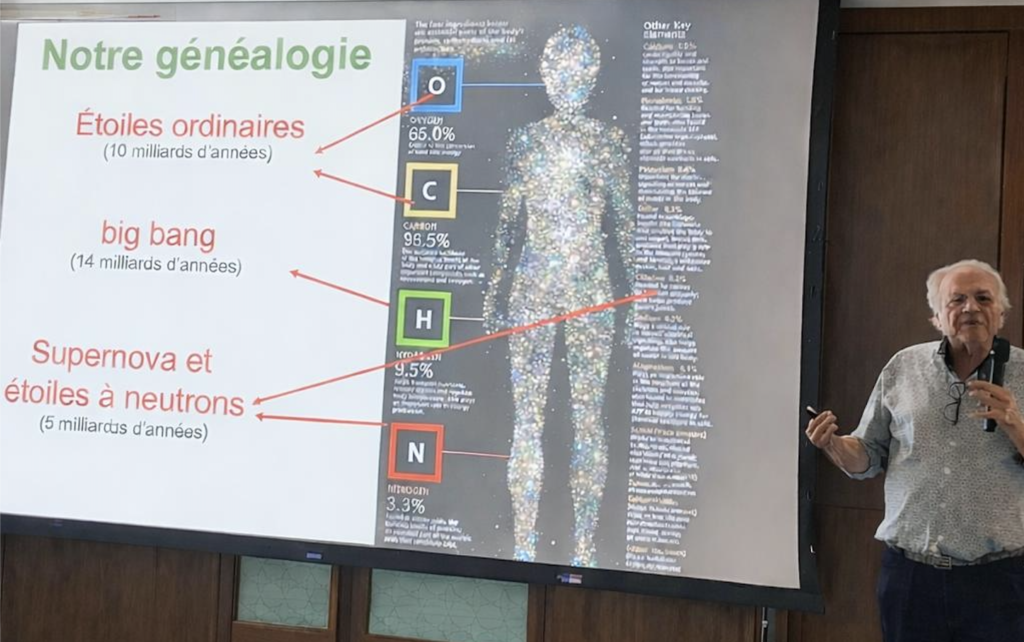
APM Bangkok conference organized by Jérôme Le Carrou: “Latest News from the Universe” with Jean-Pierre Luminet – January 2026
Between the lines: a lesson for our time
Though never framed as a program, this day carried an essential lesson for today’s societies. At a time when we are deploying ever more powerful technological systems, and when complexity often exceeds our capacity to govern, contemporary cosmology reminds us of a simple and demanding truth: power without lucidity leads to blindness.
Thinking about the Universe requires accepting uncertainty, limits and deep time. Implicitly, these may be the very intellectual demands that any profound transformation (technological, ecological or societal) should embrace if it is to last.
This day spent with Jean-Pierre Luminet was not only a scientific journey. It was a thought experiment, in the strong sense: a direct confrontation with the immensity of reality and with the constitutive limits of our understanding. It reminds us that true progress lies not in abolishing limits, but in learning to inhabit them lucidly, with humility and responsibility. And that cosmology, far from being a distant science, can still help us think about what it means to be human today, on this planet, in this Universe. This way of thinking about the Universe resonates deeply with the challenges of the Twin Transformation: accepting uncertainty, embracing deep time and designing systems capable of evolving without the illusion of total control.
To learn more, check out LUMINESCIENCES, Jean-Pierre Luminet’s blog, and a series of podcasts here

Malika Ait El Mouden explores how technologies, organizations and living systems can transform together. A digital transformation specialist with 18 years of experience in Europe, the Middle East and Southeast Asia, she has led international eCommerce and omnichannel programs. She has founded two companies, including a start-up that contributed to the development of circular solutions.
A board member of La French Tech and of the APM (Association pour le Progrès du Management), she also teaches in higher education and is following a program with MIT on the challenges of data and AI. She popularizes and spreads the concept of Twin Transformation.
Malika is the co-founder, with Julie Bonazzi, of Twin Transformation.fr