
In conversation: Laurent Baleydier answers Malika Ait El Mouden’s questions about data, natural language, information visualization and the profound shifts in our relationship to knowledge. A clear-eyed conversation about the origins of the semantic web, the promises of AI and the search for meaning in a world saturated with data.
1- Who are you, and how did you end up in tech, innovation and entrepreneurship?
My parents played a fundamental role. During the week, my mother put up with me building Lego cable cars between the rug in my bedroom and the top bunk. I would take apart the locomotive, rig a pulley to pull the string that served as the cable, and build pylons propped up on laundry detergent jugs. And on weekends, in the countryside, my father let me use his workshop to invent soapbox cars, tree houses, bird feeders… he also lent me his first computer in 1981, programmable in assembly language, which opened up a world of possibilities. So, quite naturally, I became a generalist engineer.
2- Let’s go back to KartOO: what was the ambition behind that startup, and what core insights did you explore and develop that still resonate today?
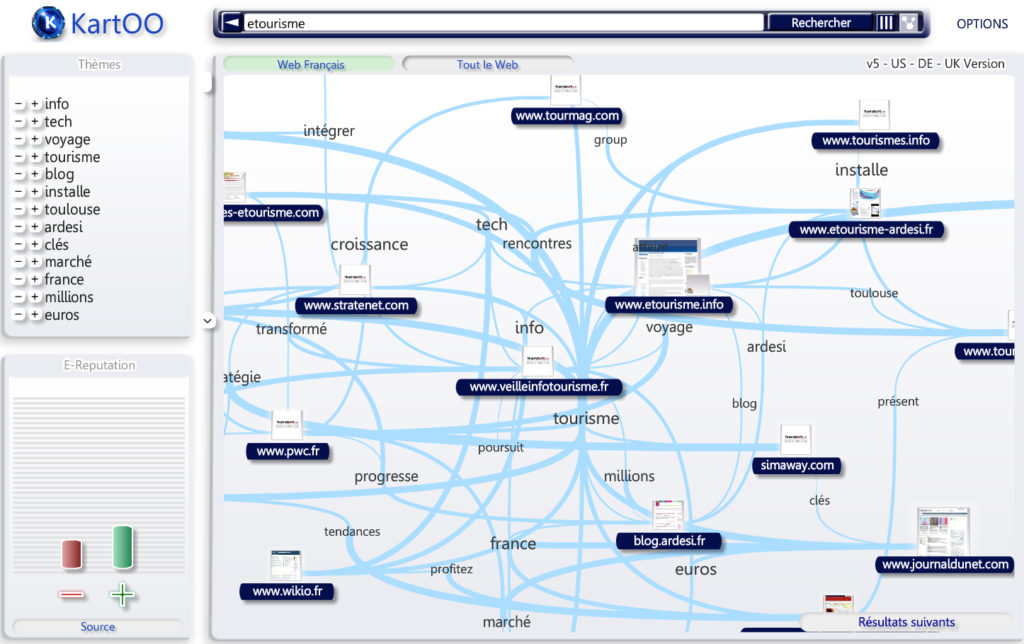
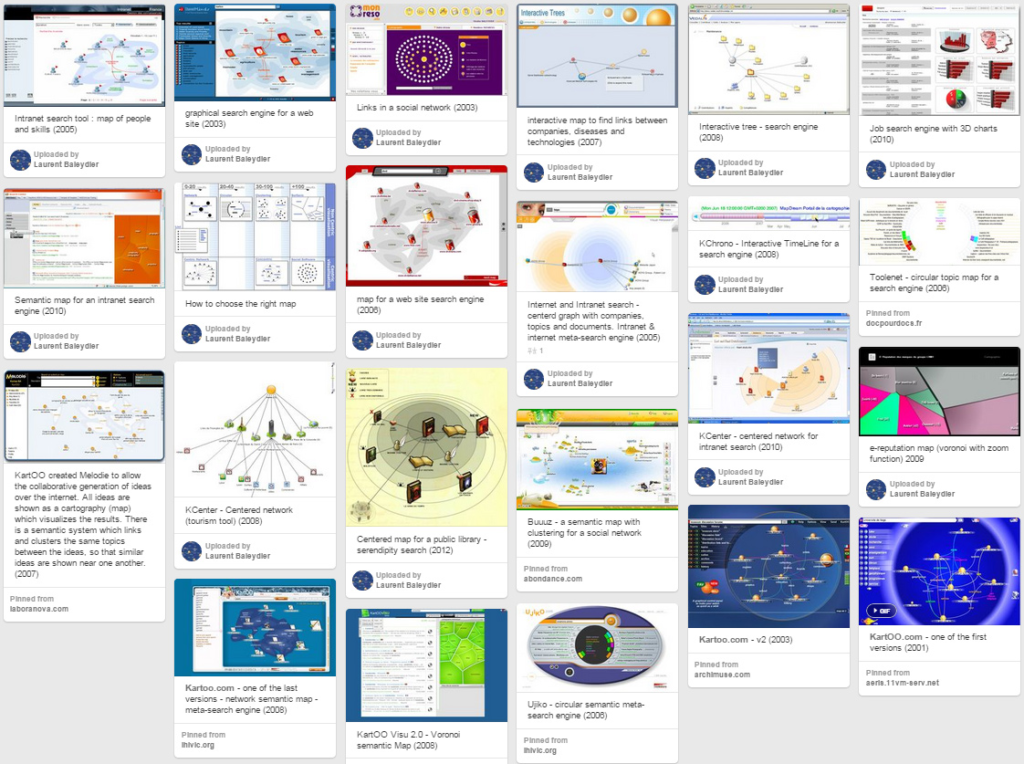
Kartoo was an unlikely cross between an encyclopedia and the solar system. In 1995, my uncle was trying to sell Hachette a range of highly innovative CD-ROMs to help people learn how to learn, focus and improve their memory. But the people he was dealing with were focused on one need: turning the company’s encyclopedias into digital tools.
Meanwhile, I was testing programs to simulate the three-body problem: when three celestial bodies attract each other, there is no mathematical solution that defines their trajectories. You have to settle for an approximate computer calculation, plotting them segment by segment. What the program produces is truly surprising: while we are used to seeing the Sun, the Earth and the Moon orbit each other with perfect regularity, most simulations show one of the 3 bodies being ejected while the other two orbit each other. But when you add more bodies and slightly change the laws of attraction, all that matter seems to come alive: the movement slows down, and the bodies arrange themselves in space and fall into sync.
So, just for fun, I replaced the celestial bodies with the encyclopedia’s definitions: the force of attraction was proportional to the number of words two definitions had in common. Once again, the program seemed to become intelligent: the whole encyclopedia turned into a kind of landscape with thematic regions, which you could zoom into to find the subject you wanted, all the way down to the definitions of words. A few years later, with the arrival of the internet, my cousin and I founded KartOO, applying the same idea to search engine results: two sites sit close together on the map if they share themes. But it wasn’t until 2024 that I made the connection between these maps and AI, while reading a book by Yann LeCun. I nearly fell off my chair: the method that lets a program learn efficiently (gradient backpropagation) uses the same equations as my system for drawing thematic maps. Since 1995, one of the keys to advanced AI had been right in front of me.
3- What did you learn from being ahead of your time?
That curiosity about the motion of the stars gave me a head start in information mapping, and my lack of curiosity about neural networks made me miss the AI train when it first left the station. It’s all a matter of perspective. What interests me is developing tools that help model the complexity of the world around us, to be in tune… with myself.
4- How do you see AI in 2026: which current advances excite you the most? What risks worry you about its mass, almost uncontrolled adoption?
Language models that can run locally are improving: you could say they are more relevant. I’d rather argue that, for the same level of performance, they use fewer resources. I run them on recycled servers powered by solar panels, to analyze news trends, for example.
To keep up with the field, I also test the large models from time to time, now that multi-agent systems have arrived. The results are mixed: there is clear progress in areas fed by huge amounts of data, such as web development, but results are more hit-and-miss in other fields such as marketing or my own area of expertise: dataviz.
And then there are the abject applications, such as using AI to wage war, letting drones decide in a split second the life or death of a dehumanized “target.”
Finally, I am worried about the younger generations. Steering an AI as an expert is exhausting, and it is easy to lose the skills you started with if you let the AI apply them without practicing. A friend, Philippe Ruby, and I created an animated series to talk about these dangers: it tells the story of Lavaa, a young volcanologist from Auvergne, who stands up to an AI that has gone rogue, taken control of media, financial markets, networks and connected objects, and is always hungry for more energy. Nature will give Lavaa an unexpected helping hand as she tries to hack the system. The message is that our happiness, and probably our salvation, depend on reconnecting with poetry and with “beauty”: technology too rarely makes us happy.
5- In your view, what principles should guide organizations in using AI (and our data) responsibly?
I think this goes beyond AI, and here again my approach is tied to my interest in complex systems: if a company prospers but destroys its social, environmental or even economic surroundings, it will disappear in the medium or long term. The same goes for us humans. If we destroy our ecosystem, life will become difficult for everyone, and competition will give way to the most common survival strategy in nature outside times of plenty: solidarity.
6- Advice for the curious and for AI enthusiasts: what would you say to those who are excited about the tool without stepping back enough to think about models, data, security and sovereignty?
Giving advice is tricky, but I’m well placed to understand how these AIs work, since they behave like the complex systems I have been designing for 20 years: the equilibrium positions, which correspond to the results, are highly variable and unstable. A small disturbance or a slightly different initial condition produces completely different results. You can limit these instabilities by strengthening the forces of attraction, but then the results are less sharp and entirely unoriginal.
You can also add a weak but constant force to steer (and therefore manipulate) the results. Finally, results change again if you expand the system: for an AI, that amounts to adding parameters. The corollary of the previous point is that an AI doesn’t know it lacks the parameters it needs to give a good answer: it doesn’t know what it doesn’t know. So trusting and depending on a tool that is unstable, open to manipulation, and configured and monitored by organizations that put ethics far behind their financial results and their national interests is as risky as driving a car with no safety inspection and no insurance!
7- What would you build today with the technologies available… that you were already exploring nearly 20 years ago?
Back then, we understood that a good data map had to be clear, beautiful and meaningful. We were strong on the first two points, and we tried to integrate semantic tools to improve the third. But they consumed enormous resources and slowed down our displays. Today, an AI would let us quickly display highly relevant keywords on the map. In fact, I am currently working on the reverse problem: offering thematic maps to help us better contextualize our requests to AIs. It’s a tool that should help us understand what is inside these black boxes.
8- If you had to pass on a single conviction to today’s innovators, what would it be?
To find the holy grail of innovation, you shouldn’t look for it directly. That is the technique of serendipity: keep the goal in mind, but explore other paths. And I would add: enjoy the process.
It’s not a magic formula; it’s a technique I have tested on many databases: if you give users a classic search tool, the keywords they type lead them to only 10% of the results. But if you give them an interface for moving from one related keyword to the next, then, link by link, they are gradually guided toward the results they were looking for. So for innovators, “Le mythe des princes de Serendip” is inspiring reading
To learn more about Laurent Baleydier, click here

Laurent Baleydier is a graduate engineer of École Centrale Marseille, an entrepreneur and a pioneer of the semantic web. Co-founder of KartOO, he was already exploring in the 2000s the links between natural language, information mapping and intelligent navigation, long before the rise of generative AI.
A specialist in data visualization and virtual reality technologies, he is among those who sensed very early the deep changes that artificial intelligence would bring to our relationship with information, knowledge and technology.