Why most AI transformation programs fail to create lasting value and what that says about our organizations.
For the first time in decades, leadership teams must simultaneously accelerate, simplify, secure, decarbonize, automate, reshore and globalize, all while cutting costs… at the same time.
We have moved past the technology problem and are now facing the organizational one. And it is the least honestly named managerial challenge of our decade!
1. The Collision of Transformations
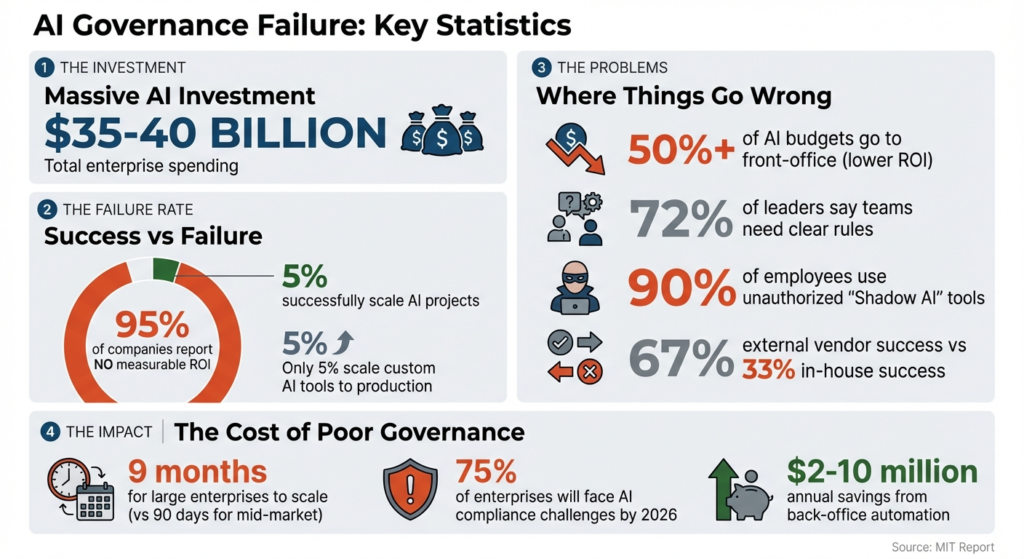
Artificial intelligence has become the symbol of our era. 88% of organizations worldwide now use it in at least one business function, up from just 55% in 20231. Every board talks about it and every strategic roadmap includes it. 69% of executives expect AI agents to transform their businesses by the end of 20262.
But behind this enthusiasm lies a quieter, even taboo reality: most organizations are not facing one transformation. They are facing the collision of several transformations… happening simultaneously.
AI is arriving at the very moment when companies are already having to deal with:
- Fragmented legacy systems, often designed in the 2000s or even earlier
- Steadily rising cyber exposure: Europe now accounts for 22% of global ransomware attacks3
- Increasingly stringent ESG and carbon requirements
- Data sovereignty in an unstable geopolitical context
- The talent shortage, including the lack of “real” AI skills, remains the top obstacle cited by executives4
- Unprecedented regulatory pressure: AI Act, NIS2, DORA
Each of these initiatives would be a major transformation program on its own. Together, they produce what complexity theorists would recognize as a nonlinear system, where interactions between variables generate outcomes that no single variable can anticipate or control.
Can the organization speed up? No, it is already at capacity.
2. The Illusion of Simplification
The dominant narrative around AI promises the illusion of simplification: faster decisions, automated processes, more agile organizations. In reality, AI does not simplify organizations. It stress-tests them.
Its deployment systematically exposes disconnected ERP/CRM/WMS/OMS and other infrastructures that were never designed to talk to each other; unresolved data ownership conflicts between business units, including external partners; duplicated processes that siloed teams had learned to work around; and governance models built for a slower, more sequential economy.
“AI improves execution, but it does not alter the structure of work. Organizations are optimizing value chains that are already inefficient. They speed up poorly designed processes without fixing their fundamental inconsistencies.”
Source: WEF-Accenture, AI and Business Transformation Report, March 20265
The uncomfortable truth that many organizations discover during deployment is this: before they can use AI effectively, they must first admit that their operating model was never designed to work in real time. That is why so many AI projects remain stuck at the pilot stage. The constraint is rarely technological. It is mostly structural and contextual.
The Contradiction Few Leaders Name Openly
Consider the typical board agenda in 2026. Executives are being asked, all at once, to accelerate AI adoption, reduce their carbon footprint, strengthen cybersecurity, protect data sovereignty, cut operating costs, innovate faster and maintain a human-centered approach.
Taken individually, each of these goals is legitimate and defensible. Collectively, they produce major strategic contradictions that most leadership teams are reluctant to name.
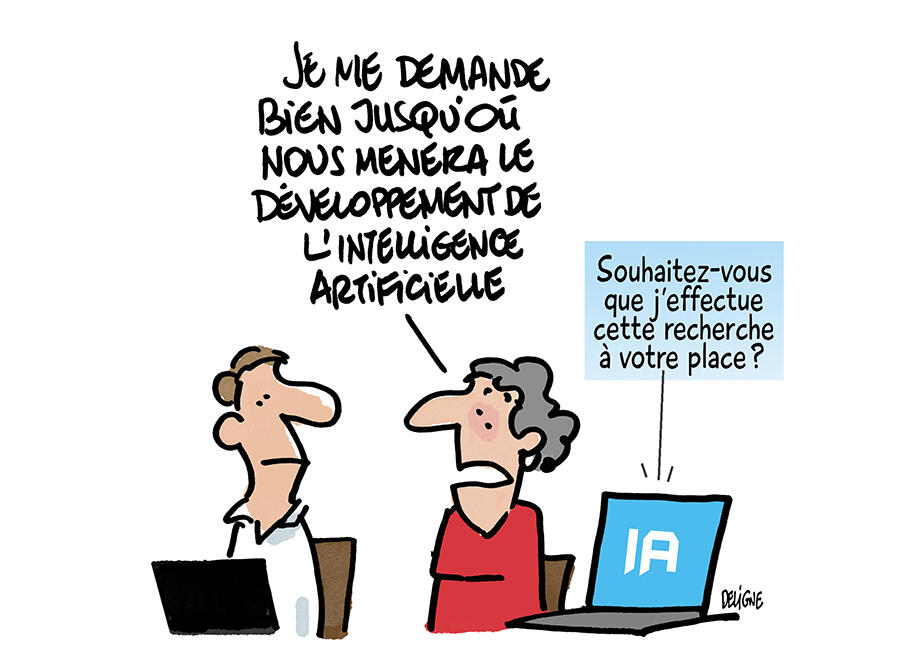
Source: Journal du CNRS – IA et valeurs humaines : un problème d’alignement
3. AI as a Mirror of Governance
Most companies still manage transformations in silos: IT handles infrastructure, sustainability handles carbon, legal handles compliance, operations handle efficiency, HR handles adoption, and so on… AI (and digital transformation, in parallel) by its very nature breaks down these boundaries.
The reason so many companies feel overwhelmed despite massive investment is that their operating model remains fragmented while their risks have become deeply interconnected. The organization itself becomes the main constraint on transformation.
A particularly worrying signal confirms this diagnosis: according to Gallup, manager engagement has fallen by 9 points worldwide since 2022, including 5 points between 2024 and 2025 alone6. Yet the top two drivers of real AI use in organizations are technical integration into existing systems and active support from the direct manager, ahead of company policy or the availability of tools. In other words, AI transformation is being entrusted precisely to those whose engagement is collapsing fastest and who receive little or no support.
4. The Era of Performative Transformation
The vocabulary is everywhere: responsible AI, Green AI, resilience, governance, human-centric design, digital sustainability. The language is sophisticated and the intent is often sincere.
But behind the rhetoric, many still operate with fragmented data architectures, governance structures designed for a pre-digital economy, KPIs that contradict each other from one function to the next, and incentive systems that favor short-term local optimization over overall coherence.
The figure is telling: only 34% of executives are truly reinventing their business model in the face of AI4. The rest optimize at the margins. The consequence is subtle but significant: transformation becomes theatrical rather than structural. This is what is now called “transformation washing”.
AI pilots multiply, dashboards proliferate, steering committees meet, reports are produced. But organizational complexity grows faster than value creation! And the gap between what is communicated externally and what is experienced internally widens silently, gradually, until it becomes a credibility problem.
5. The Next Competitive Advantage: Organizational Coherence
The organizations that will dominate the next decade will probably not be those that have deployed (and interconnected) the most AI agents. They will be those able to reconcile contradictory transformations faster than their competitors.
The emerging differentiator is not technological capability but governance coherence across functions and priorities, systems thinking at the leadership level, cross-functional trust as an organizational asset, and the ability to arbitrate between legitimate but competing imperatives.
This requires a profound shift in leadership mindset: moving from transformation as deployment to transformation as design.
The questions that change everything:
- Which decisions must remain human by design?
- Which trade-offs are we truly ready to own?
- Where does our data actually reside, and who controls it?
- Which legacy systems are silently blocking transformation while we build on top of them?
- Are we really reducing complexity, or are we industrializing it?
The future of transformation may depend less on the intelligence of our systems than on our collective ability to build organizations coherent enough to use them with discernment.
Sources
- McKinsey Global Survey on AI, 2025
- DeepL & Censuswide: survey of 5,000 executives, December 2025
- Forrester Cybersecurity Predictions 2026 / Euronews Next, January 2026
- Deloitte: State of AI in the Enterprise, 2026
- WEF-Accenture: AI and Business Transformation Report, March 2026
- Gallup: State of the Global Workplace 2026 Report, April 2026

Malika Ait El Mouden explores how technologies, organizations and living systems can transform together. A digital transformation specialist with 18 years of experience in Europe, the Middle East and Southeast Asia, she has led international eCommerce and omnichannel programs. She has founded two companies, including a start-up that contributed to the development of circular solutions.
A board member of La French Tech and of the APM (Association pour le Progrès du Management), she also teaches in higher education and is following a program with MIT on the challenges of data and AI. She popularizes and spreads the concept of Twin Transformation.
Malika is the co-founder, with Julie Bonazzi, of Twin Transformation.fr