
Why AI forces us to think about cognitive sustainability.
We keep asking what AI can do. The more important question may be what we, as human beings, risk no longer learning to do.
After twenty years working on corporate digital transformation, from CRM to ERP, from data to logistics flows, I have learned one lesson: we almost always understand a transformation only after living through it and carrying it out. In the moment, we see tools, channels, processes optimized one by one, teams reorganized. Only later do we grasp what the whole has changed.
Generative AI is following the same path, with one major difference. It is no longer just changing how we produce, operate or sell. It reaches into what we do with our minds: thinking, searching, writing, arguing, deciding. And it is reaching children and teenagers whose abilities are still developing. A child born in 2012 was ten when ChatGPT arrived. They will be eighteen in 2030. Much of their intellectual development will happen alongside tools capable of doing the work for them. No one yet knows what the real effects will be!
We Have Always Delegated, So What Is Really Changing?
The objection comes right away, and it is fair. Writing did take the load off memory, calculators off arithmetic, GPS off navigation. Psychologists call this cognitive offloading (Risko and Gilbert), and it is one of the engines of human intelligence. Plato, after all, was already worried about writing. What has changed is mainly the scope. A calculator does the calculation, but does not choose the problem; a GPS finds the route, but does not pick the destination. A generative model steps in at every stage: framing the problem, finding information, sorting it, forming hypotheses, writing the conclusion. The question is no longer whether we delegate, but how far. Two Wharton researchers, Shaw and Nave, speak of “cognitive surrender” to describe the moment we accept the AI’s answer and stop reasoning for ourselves.
Doing Better Is Not Learning Better
A student who uses AI to hand in a better essay than the one they would have written alone has improved the paper, but has not necessarily made any progress themselves!
A study of high school math students illustrates this clearly (Bastani, 2025). With unrestricted access to a language model, students do markedly better on practice problems, by about 48%. But on the exam, without the tool, they score about 17% lower than those who never had access to it. A “tutor” version, which guides without giving the answer, avoids most of this loss. When AI does the very exercise meant to teach us, learning always suffers. When it takes a side task off our hands, it can actually help. Having AI reformat your notes so you can spend more time on a concept is nothing like having it build the reasoning you are supposed to master. Augmented performance is not augmented skill.
Not All Friction Should Be Removed
For twenty years, my job was to remove friction: fewer clicks, shorter user journeys, simpler and smoother payment, faster logistics and processes. When the goal is to sell, that logic is right, even if it is overly consumerist. The mistake would be to make it a general rule.
When it comes to learning, some difficulties are useful. Psychologist Robert Bjork calls them desirable difficulties: retrieving information from memory or spacing out study sessions, for example. These efforts slow us down in the moment, but help us remember for longer. Searching, getting it wrong, tinkering, writing, starting over: it is unpleasant precisely because that is where skills are formed and take lasting root.
I call this formative friction, as opposed to useless friction. Good technology should remove the latter and preserve the former. A good AI tutor should know when not to answer right away: ask for a hypothesis, have the student explain their reasoning. It would then be judged on what the student can do without it, not on the quality of the answers it helps them produce.
When AI Becomes a Confidant
Teenagers do not just work with AI: they talk to it. According to a survey published in 2026 in JAMA Pediatrics, nearly one in five Americans aged 12 to 21 has asked a chatbot for mental health advice, and most told no one (McBain).
This can help: it offers a first place to voice a worry without fear of being judged. But a human relationship also means waiting, negotiating, living with disagreement, patching up a fight, accepting that the other person is not always available, whereas a chatbot removes all these constraints. It is always there, patient and accommodating. What do we learn about relationships when the most available companion needs nothing in return? This question does not require us to know whether machines are conscious. Science cannot answer that, and researchers working on indicators of artificial consciousness remain very cautious (Butlin). But a machine does not need to be conscious to be treated as if it were. If a child believes it feels something and grows attached to it, the effects on that child are very real, aren’t they? And could we end up living with the consequences of artificial consciousness before it exists and before we can even name it?
The Junior…Who Will Never Become a Senior
The same problem arises in business. With AI, a junior produces in ten minutes the analysis that used to take a senior three hours to build: the gain is immediate. But how will that junior ever become a senior?
We learn a trade by doing the intermediate tasks and getting our hands dirty. Consultants learn by analyzing, lawyers by drafting, developers by debugging… These are precisely the tasks AI automates. Researcher Matt Beane observed this in robotic surgery: as the machine made the resident less necessary, residents learned less alongside the surgeon, and some could only get trained by bending the rules.
Automating a task is not the same as automating the experience through which we learn it.
Cognitive Sustainability
Digital transformation eventually ran up against the planet’s limits: energy, water, metals. AI is bringing us up against another limited resource, our own human capacities. There are no measurable cognitive thresholds the way there are for the climate. But learning, judging, creating and relating to others take time, challenge and experience, and no efficiency gain shortens that. We define cognitive sustainability as a technology’s capacity to expand what we can do without weakening what our learning, judgment and autonomy depend on. This is not about nostalgically defending skills the machine performs better than we do. It is about making sure that a performance gain today does not consume the capacities we will need tomorrow, with one another.
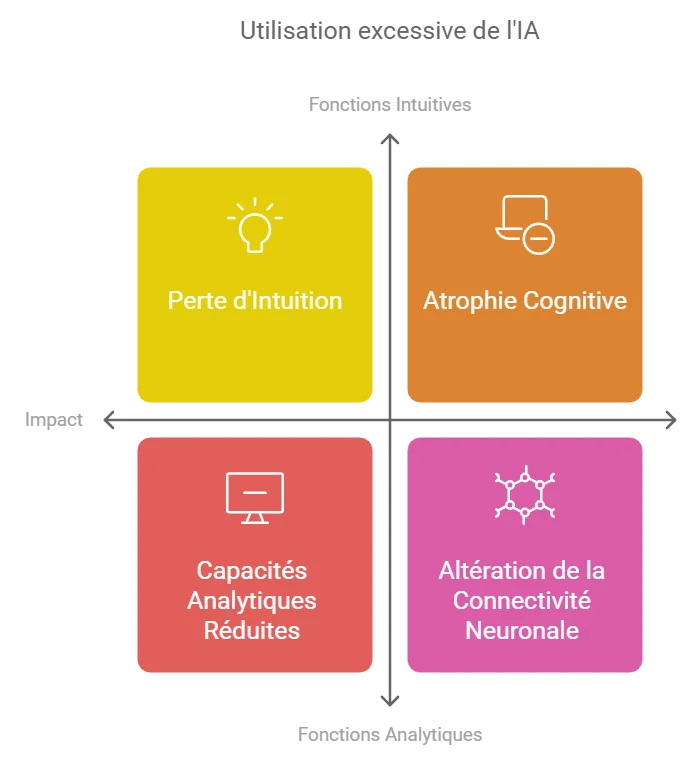
This risk is well known. As early as 1983, Lisanne Bainbridge showed that the more effective a plant’s automation, the less operators practice the skills they will need the day it breaks down. Today the same pattern shows up at three levels: the school that gets good answers with AI but no longer teaches students to answer without it; the company that makes its juniors productive but no longer produces seniors; the individual who does more with the tool but can no longer check what they produce.
sources: https://iana-data.org/
What Is Worth Not Delegating
AI can broaden access to knowledge and free us from many pointless tasks. The real question lies elsewhere: what is worth not automating, even when we know how? The answer rests on a simple distinction. For some activities, only the result counts: when I take a taxi, I just want to get there. For others, the journey matters as much as the destination: when I learn mathematics, it is the effort that transforms me. Delegating a low-stakes administrative memo saves time. Delegating the reasoning I am supposed to learn means losing exactly what the effort was meant to produce.
In 1971, H. Simon observed that an abundance of information (infobesity) creates a scarcity of attention. AI now makes intellectual production itself abundant. The next scarce resource may be undelegated human experience: what we have searched for, understood and built ourselves.
For the next generation, the question is not only at what age to teach them to use AI. It is which capacities we want to give them time to build before offering to delegate them. The recent history of social media should at least make us cautious. For years, we let it into the lives of children and teenagers before we understood its effects well enough. Today, some countries are starting to set an age limit: in Australia, since December 2025, major platforms have had to prevent under-16s from holding an account. eSafety Commissioner
There is something troubling about the way we adopt technologies: we deploy them at scale, then observe their effects, and only afterwards build the safeguards.
With AI, the risk may be even harder to see: if certain capacities are not built when they should be, how will we later measure what was never acquired? Twenty years of digital transformation should have taught us to avoid this cycle: deploy first, measure later and, too often, understand too late. With AI, we have the opportunity and the responsibility not to wait twenty years.

Malika Ait El Mouden explores how technologies, organizations and living systems can transform together. A digital transformation specialist with 18 years of experience in Europe, the Middle East and Southeast Asia, she has led international eCommerce and omnichannel programs. She has founded two companies, including a start-up that contributed to the development of circular solutions.
A board member of La French Tech and of the APM (Association pour le Progrès du Management), she also teaches in higher education and is following a program with MIT on the challenges of data and AI. She popularizes and spreads the concept of Twin Transformation.
Malika is the co-founder, with Julie Bonazzi, of Twin Transformation.fr