ASEAN faces a convergence of constraints
The conference “Towards a Sustainable and Energy-Resilient Southeast Asia by 2050” organized by MIT ASEAN should be read as a weak signal that has become a strong one: the signal of a region entering a phase of structural decision-making, where energy choices stop being sector-specific and become determinants of sovereignty.
ASEAN sits at the intersection of three major dynamics:
- structural growth in energy demand, estimated at between +50 and +60% by 2040,
- persistent dependence on fossil fuels, with an energy mix still largely dominated by coal and gas,
- acute climate vulnerability, in a region where the physical impacts of warming are already observable, documented and far from theoretical
Unlike Western economies, the region has not yet locked its energy system into massively irreversible infrastructure. This absence of full lock-in is a rare but transient opportunity. Recent history shows that energy systems, once stabilized, become extraordinarily resistant to change, not for technological reasons, but for institutional, financial and (geo)political ones.
Bringing together public and private players and think tanks, this two-day conference takes place at a tipping point, as trajectories are taking shape but are not yet set.
Western lessons and the risk of strategic dependence
In early 2026, Europe is no longer in a cyclical energy crisis, but in a structural crisis of sovereignty. Persistent price volatility, fragile grids, import dependence and lasting geopolitical tension have exposed a reality that is now hard to dispute: the European energy system was designed for a stable world that no longer exists.
Market integration came before securing supply, the transition was designed without assuming major disruptions, and economic optimization long took precedence over resilience. The result is a decision-making lock-in: the options exist technically, but are politically, financially or socially costly to activate.
The United States has more room for maneuver thanks to its resources, but remains held back by chronic political fragmentation. China, by contrast, openly pursues a strategy of energy control: rapid decarbonization where it strengthens its industrial power, sticking with coal where stability comes first. In all three cases, energy has become a tool of geopolitical projection, not merely an economic commodity.
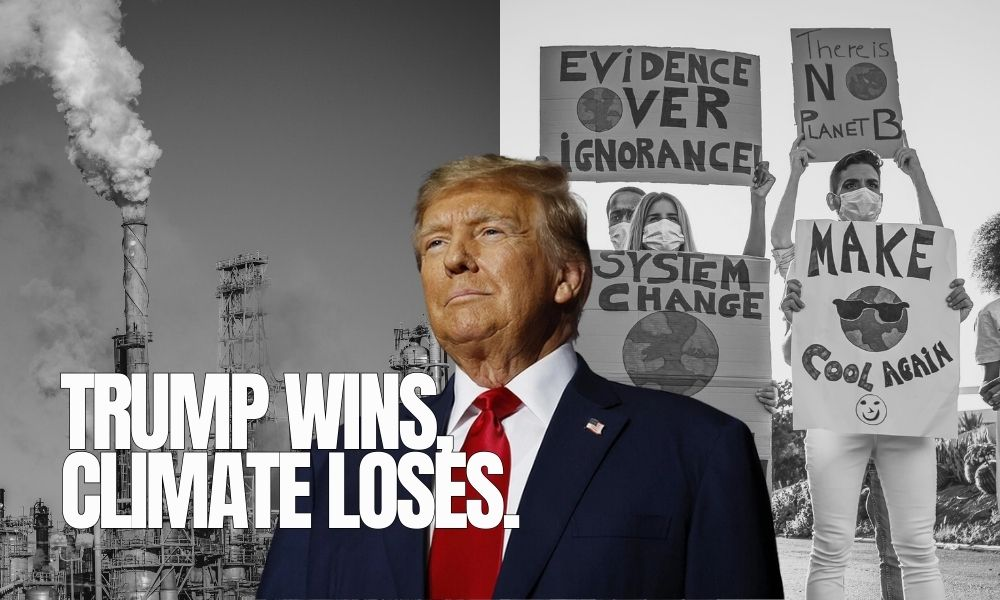
Credit: netnada.com
For ASEAN, the signal is clear. Importing technologies, capital or standards without controlling the associated dependencies amounts to postponing the problem, not solving it. The energy transition is now inseparable from a central question: who decides, and under what constraints? In other words, the energy transition is not only a transition of resources. It is a reconfiguration of power relations. And that is precisely what ASEAN must take on board if it wants to avoid reproducing, in other forms, the dependencies it observes elsewhere today.
From modeling to decision: En-ROADS and the MIT climate approach
At the heart of the conference, the En-ROADS tool embodies a profound shift in how energy and climate issues are approached. En-ROADS is neither a forecasting tool nor a decision-support instrument in the classic sense. It is a systems simulator, designed to expose complexity rather than reduce it.
Developed by Climate Interactive in collaboration with MIT, the tool is now closely associated with the work of the MIT Climate Policy Center, led by Bethany Patten.
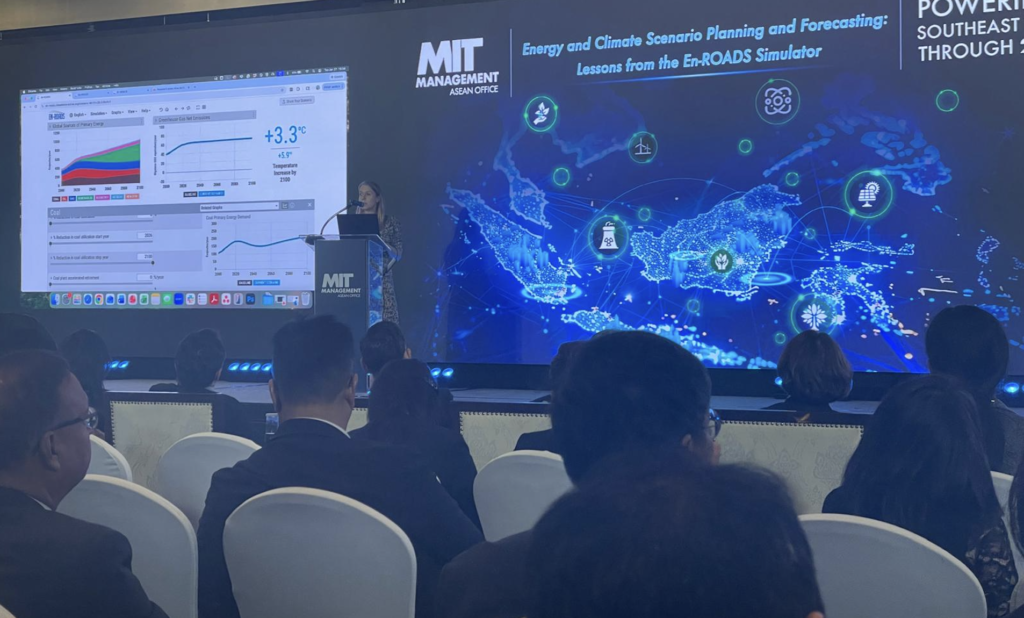
Powering Southeast Asia through 2050 Conference – Bangkok – January 2026
Freely accessible to all, En-ROADS models the dynamic interactions between energy policies, greenhouse gas emissions, climate trajectories, economic costs and social behaviors, at a global scale and through the end of the century. Its fundamental contribution lies in what it makes visible: the inertia, the lock-in effects, the rebound effects and the time lags that characterize real energy systems.
The approach championed by the MIT teams is deliberately demanding. En-ROADS does not provide a turnkey “right answer”. On the contrary, it shows that:
- no single lever is enough to reach climate-compatible trajectories,
- decisions made today heavily shape the options available 20 to 40 years from now,
- and any credible trajectory involves explicit trade-offs between growth, costs, climate and social acceptability.
This positioning is central. Climate change is not treated as a technological problem to be solved, but as a problem of governing complex systems. The tool does not replace political decision-making; it reveals its consequences and turns intuition into quantified reasoning, and conviction into a testable hypothesis.
At a time when energy choices are increasingly constrained by geopolitics, the economy and the climate, En-ROADS illustrates a strong conviction held by MIT Climate: the intelligence that matters is not the kind that optimizes a single parameter, but the kind that anticipates irreversibilities and brings externalities to light.
Climate and geopolitical constraints are tightening, and the truly strategic resource is no longer energy itself, but the ability to decide before lock-in.

Malika Ait El Mouden explores how technologies, organizations and living systems can transform together. A digital transformation specialist with 18 years of experience in Europe, the Middle East and Southeast Asia, she has led international eCommerce and omnichannel programs. She has founded two companies, including a start-up that contributed to the development of circular solutions.
A board member of La French Tech and of the APM (Association pour le Progrès du Management), she also teaches in higher education and is following a program with MIT on the challenges of data and AI. She popularizes and spreads the concept of Twin Transformation.
Malika is the co-founder, with Julie Bonazzi, of Twin Transformation.fr