
For several decades, we thought of digital technology as an immaterial, light, abstract world.
But as French engineer Philippe Bihouix, a central figure in low-tech thinking, reminds us:
“Technology is never immaterial: it is a concentrate of metals, energy and engineering.”
Simple as it sounds, this sentence captures a profound shift. At this scale, the growth of digital technology now collides head-on with physical limits: energy, metals, infrastructure.
According to the International Energy Agency (IEA):
- digital technology accounts for 6 to 9% of global electricity
- datacenters could reach 1,000 TWh/year by 2030!
- a 160% increase in less than ten years
Booming generative AI is accelerating this dynamic even further. Training a large model requires 20 to 25 GWh; running it day to day consumes even more. Digital is no longer a “cloud.” It is a global energy infrastructure, as material as the steel and copper that make it up.
The second wall: complexity turns into entropy
Donella Meadows, a pioneer of systems thinking, wrote:
“Systems collapse when they exceed their manageable complexity.”
In eCommerce digital transformation, I have seen exactly this for nearly 20 years: we use only 15 to 20% of the capabilities of the platforms we deploy. This logic produces three systemic effects: increased technical debt, operational fragility and needless (over)consumption of energy. Not to mention the complexity it creates within organizations and for teams.
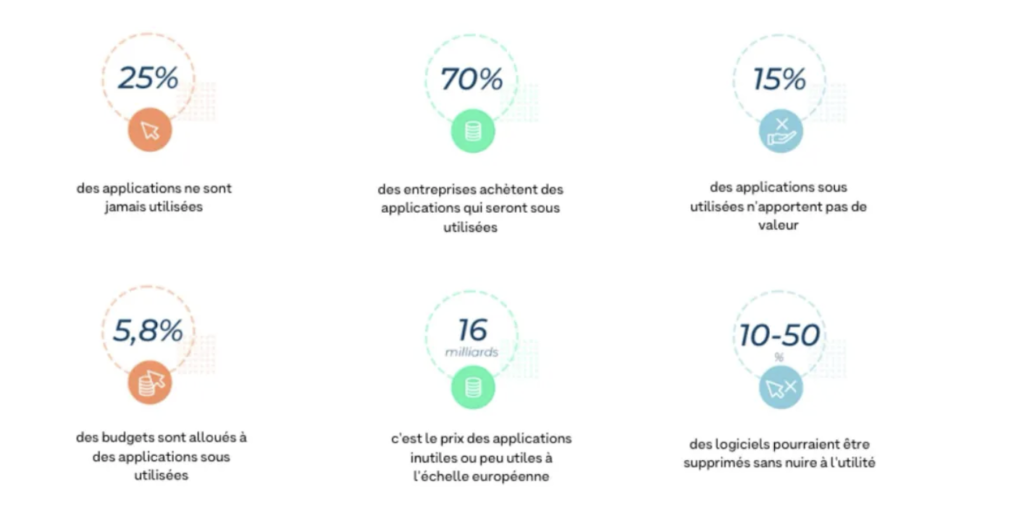
Sources: Institut du Numérique Responsable
Within the low-tech field, this dynamic has led to a formal set of design criteria for breaking away from the logic of technological stacking.
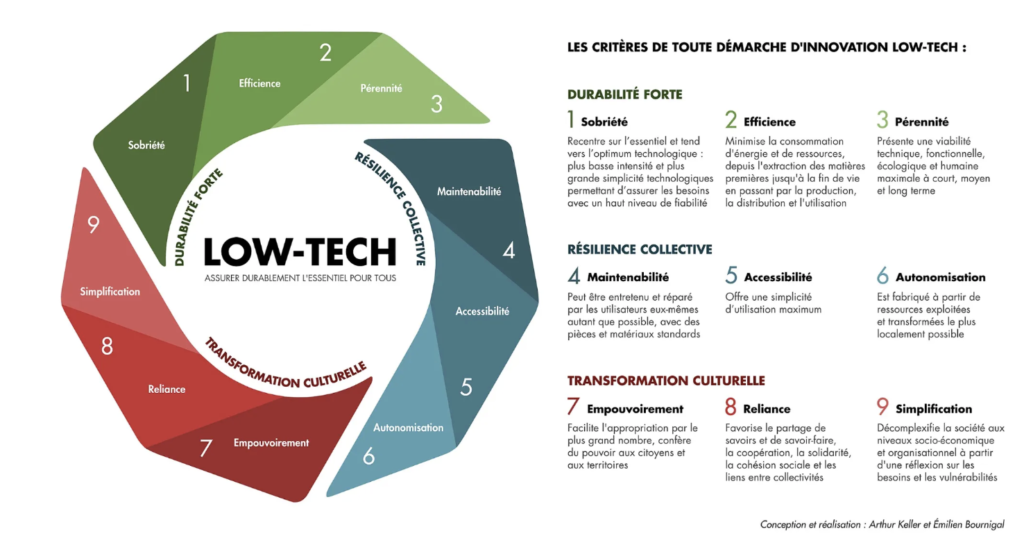
Source: Low-tech: the nine criteria of a technologically sustainable design
While low-tech is often described as a philosophy or a cultural movement, it actually rests on a precise engineering framework that is rigorous and deeply operational. Contrary to the popular image of “less advanced” technology, low-tech offers a design methodology that aims to align technical systems with the physical limits of the world, while maximizing their robustness, autonomy and longevity.
This framework, developed in particular by French researchers and engineers such as Philippe Bihouix, Arthur Keller and Émilien Bourigault, rests on nine criteria for assessing the real sustainability of a technological innovation. These criteria are not ideological: they are systemic principles drawn from engineering science, industrial ecology and life cycle assessment.
They cover three essential dimensions: strong sustainability, collective resilience and cultural transformation.
Together, they form a grammar of sustainable technological design: a set of simple but foundational rules for designing systems that are more sober, more robust, easier for users to make their own and better aligned with real needs.
AI as a mirror: the genius and the cost
AI’s results are extraordinary! But they are driven by energy growth that is becoming hard to sustain. According to Jonathan Koomey, a leading global expert on the subject:
- AI could account for 10 to 15% of global electricity demand by 2035 if nothing changes
- inference is becoming the dominant cost, far outweighing training
A hyperscale datacenter consumes up to 500 MW, the equivalent of a city of 300,000 inhabitants!
As Neil Gershenfeld (MIT) puts it:
“The future does not lie in ‘ever more computing,’ but in computing that is right-sized, distributed and intelligently orchestrated.”
That is exactly the low-tech proposition!
Low-tech: a science of right-sizing
Despite the caricatures, low-tech is neither a renunciation nor a backward-looking approach. It is an engineering discipline, structured and demanding.
Philippe Bihouix sums up the vision:
“ True innovation is the kind that optimizes, not the kind that oversizes.”
Low-tech rests on four solid scientific principles:
1. Structural sobriety
Shrink technology stacks; 30 to 50% of software components serve no measurable purpose.
Removing them lowers:
- energy consumption (-25% to -40%),
- cloud costs (-20% to -50%),
- systemic risk
2. Computational frugality
Minimize the demand for computing rather than maximize power. TinyML, quantization and distillation enable:
- models 100 times smaller
- consumption up to 1,000 times lower
- local execution
3. Longevity and repairability
Extending hardware lifespan by 3 years reduces a piece of equipment’s total footprint by 60%.
4. Distributed resilience
Architectures able to operate in degraded mode, locally, without a permanent cloud connection, with partial self-consumption.
For decades, we have equated technological mastery with a logic of addition: one more (over)layer, one more feature, one more server. But all true ingenuity eventually meets a moment of truth, when we understand that what matters lies not in accumulation but in refinement.
Philippe Bihouix sums this up in one clear sentence:
“High technology needs low-tech to remain sustainable.”
This is not a criticism: it is a law of balance. Every complex system must rest on a simple, stable and durable base, and on an infrastructure that does not collapse under its own weight.
Echoing much of the work in systems engineering, notably at MIT, one could say that a well-designed system is one that breathes, that lets energy, attention and maintenance flow without unnecessary friction. It is not a bloated organism; it is a right-sized architecture. So the next digital revolution will be neither a step backward nor a headlong rush forward. It will be neither high-tech nor low-tech, but right-tech: technology that is proportionate, under control, optimized for real value, governable over time, aligned with the limits of the world and, at last, built to last.
Because true sophistication is not what impresses, but what holds up!
It is not what promises the infinite, but what builds stability and fits within the coherence of living systems. And it is there, in this rediscovered coherence, that the quiet revolution low-tech is opening up today begins. But in the meantime, how do we manage the technical debt that has piled up over the years?

Malika Ait El Mouden explores how technologies, organizations and living systems can transform together. A digital transformation specialist with 18 years of experience in Europe, the Middle East and Southeast Asia, she has led international eCommerce and omnichannel programs. She has founded two companies, including a start-up that contributed to the development of circular solutions.
A board member of La French Tech and of the APM (Association pour le Progrès du Management), she also teaches in higher education and is following a program with MIT on the challenges of data and AI. She popularizes and spreads the concept of Twin Transformation.
Malika is the co-founder, with Julie Bonazzi, of Twin Transformation.fr