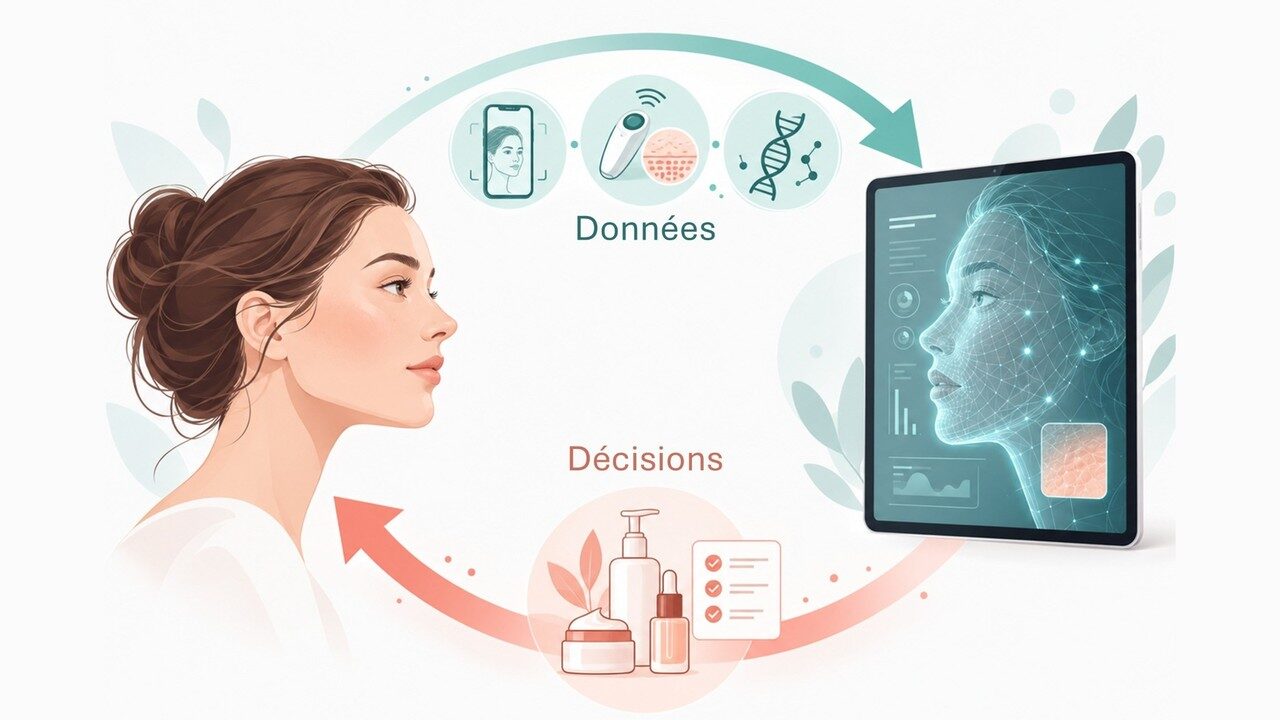
A digital twin is a virtual double that evolves alongside the real object. Twins are already built for aircraft engines, factories and, more recently, patients’ hearts and brains. Skin, an organ that can be photographed, measured and sampled painlessly, is one of the areas where the idea is moving fastest. It is also one where the term is most overused. Here is how to tell what is what.
From Aircraft to Skin: An Idea on the Move
The idea comes from industry. In the early 2000s, American engineer Michael Grieves proposed pairing each product with a computer copy fed by data from the physical product. NASA adopted the term in 2012 for its vehicles, where the double helps engineers see failures coming rather than wait for them.
Healthcare picked it up a decade later. Cardiac twins are already used to plan procedures, and since late 2023 the European Union has been funding a virtual human twins program. The healthcare digital twin market, worth $7.5 billion in 2026 according to MarketsandMarkets, could grow thirteenfold by 2031. Figures like these should be taken for what they are (consultancy projections), but they show how much interest the field is attracting.
Why skin? Because it is the easiest organ to observe. A smartphone photo, a hydration sensor stuck to the forearm, an adhesive disc that lifts a few cells from the cheek, and you have data without a scalpel, at home, every day. That is exactly what a twin needs: frequent, inexpensive measurements.
Model, Shadow or Twin: The One-Question Test
Not everything called a “twin” is one. The test comes down to a single question: which way does the data flow?
- Someone enters values by hand and the program runs once? That is a model. Useful for understanding a mechanism, but static: it knows nothing about your skin in particular.
- Data flows automatically from the skin to the program, which updates itself? That is a shadow. The app that scores your skin from your selfies every morning is one. It follows you; it decides nothing.
- The program also sends decisions back to the skin (an active ingredient, a routine, a device setting), then measures the outcome to correct itself? That is a twin. The loop is closed.
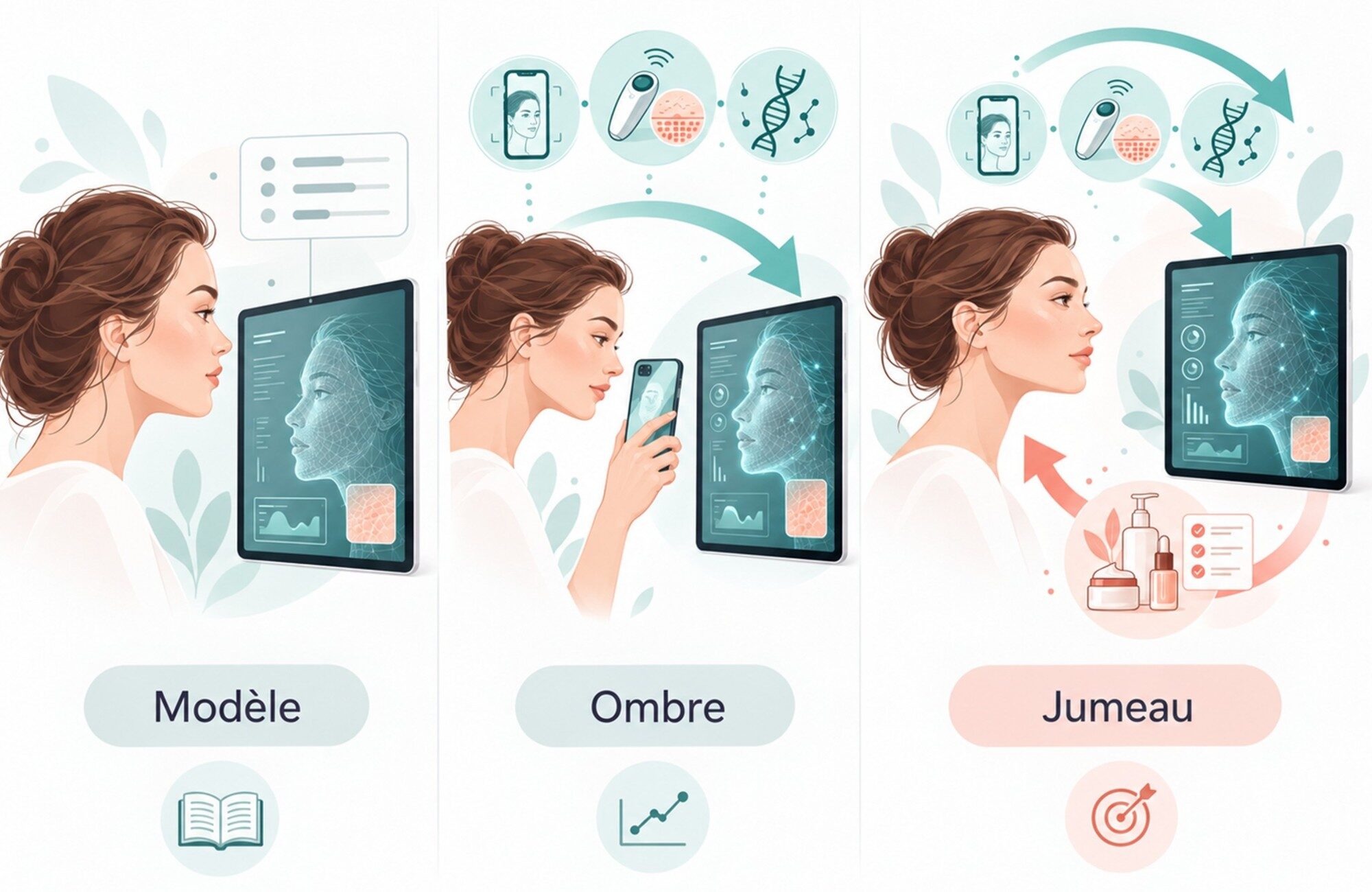
Apply this test and most of the “skin twins” announced today turn out to be shadows, sometimes mere models. That is not a criticism: the shadow is a necessary stage on the way to a twin. It is a question of vocabulary, and vocabulary matters when it is used to sell.
What a Real Skin Twin Would Change
In practical terms, three things.
Predict rather than describe. A skin diagnosis tells you how your skin is doing today. A twin would tell you how it will be doing in five years, by combining its biological age, your exposures (sun, pollution, climate, products, stress…) and models of aging.
Test before applying. Try out a routine or an active ingredient virtually, and keep only what works on your skin, not on the average of a volunteer panel.
Run fewer, better-targeted trials. Models already simulate what happens to an ingredient once it is applied, so its safety can be assessed without animals. Others predict how clinical trial participants will progress, so fewer need to be recruited for the same level of evidence; the European Medicines Agency approved this approach for drug trials in 2022. For an industry that has had to substantiate its claims without animal testing since 2013, this is the most immediate benefit, and the most frugal one.
Where Do We Really Stand?
The gap between brands’ promises and published results remains wide, but it is narrowing.
- On the research side, a systematic review published in 2024 found no study that had actually implemented a digital twin in dermatology. The first prototypes focus on chronic wounds. From photos taken at successive dressing changes, the program learns what normal healing looks like and flags when the actual wound departs from that trajectory.
- On the consumer side, in January 2025 L’Oréal unveiled Cell BioPrint, a device that analyzes proteins sampled from the cheek in five minutes and estimates the skin’s biological age. Strictly speaking, it is a shadow: it measures and predicts, but does not yet close the loop.
- On the industry side, in April 2026 Groupe Rocher and Dassault Systèmes announced a virtual twin of their active ingredients and of the skin, designed to simulate penetration and efficacy ahead of lab testing and cut the number of tests by 20%.
The pieces of the puzzle are on the table: models of cells, tissue and active ingredient absorption, sensors, algorithms. No one has yet assembled them for a specific person, or shown that the combined system makes accurate predictions.
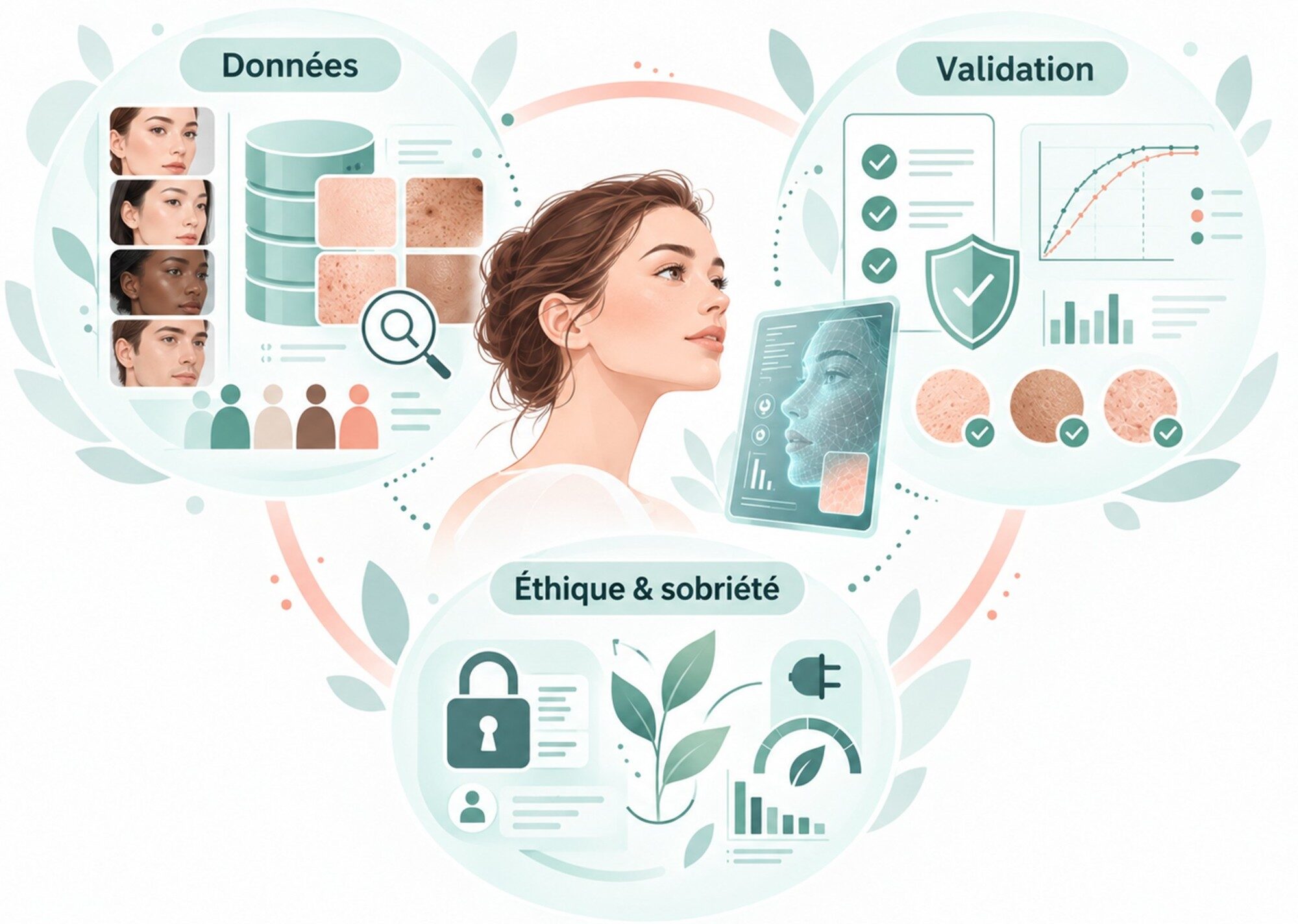
Three Reasons to Wait Before Buying In
Data. It is scattered across apps, clinics and laboratories, rarely tracked over time, and not very diverse. PhotoAgeClock, one of the most cited visual clocks, was trained on 8,414 photos of the eye corners of Caucasian women aged 20 to 80. Show it a dark-skinned man’s face and it will return an answer with the same apparent precision, even though it has never been tested on that skin type. A twin trained on too homogeneous a population inherits its blind spots, and nothing in its results flags them.
Validation. A twin that is confidently wrong is worse than no twin at all. In November 2023, the FDA published guidance that scales the evidence required of a model to the seriousness of the decision it informs. There is no equivalent for cosmetic claims, and a marketing “twin” can be sold without anyone having checked its predictions.
Ethics and sobriety. With facial photos, genetic data and continuous monitoring, the twin concentrates the most sensitive data there is. The framing note published in September 2025 by the French Digital Health Delegation points out that a prediction is a probability, not a destiny, that a person cannot be reduced to their double, and that every computation has an energy cost to be weighed against its benefit. This is the point to hold firm on. A twin that runs nonstop to recommend a face cream has to justify every watt.
Key Takeaways
- A digital twin closes a loop: data flows up, decisions flow back down, and each cycle brings a correction. Without a loop, it is a shadow or a model.
- For skin, the pieces exist; the validated assembly does not. The commercial “twins” of 2026 are shadows.
- The most immediate benefit is not the consumer app but fewer, better-targeted trials, on animals and humans alike.
Further Reading
- Délégation au numérique en santé, Jumeaux numériques en santé: enjeux, définitions et problématiques éthiques, framing note, September 2025.
- European Commission, launch of the Virtual Human Twins initiative, December 2023.
- Akbarialiabad H. et al., Digital twins in dermatology, current status, and the road ahead, npj Digital Medicine, 2024.
- Bobrov E. et al., PhotoAgeClock, Aging, 2018.
- MarketsandMarkets, Digital Twins in Healthcare Market, April 2026.
- U.S. Food and Drug Administration, Assessing the Credibility of Computational Modeling and Simulation in Medical Device Submissions, guidance, November 2023.

Rachida Nachat-Kappes is the founder of InnovSkin and holds a doctorate in human biology and pathophysiology (Université Paul Sabatier Toulouse III, Pierre Fabre Laboratories). Passionate about skin biology, she has worked with world-renowned researchers, Dr Michel Simon, Prof. Fiona Watt and Prof. Akemi Ishida-Yamamoto, and contributed to academic research projects with the LVMH and Pierre Fabre Laboratories. She then moved into the cosmetics industry with one goal: proving the efficacy of active ingredients. At Greentech, she took part in developing several innovative actives, now widely recognized. With InnovSkin, she works to transform cosmetics through science, designing rigorous concepts for products with proven results.