
Strategic thinking and a maturity tool.
Transformation has almost become a permanent goal. We digitalize, we decarbonize, we overhaul, we reorganize. The movement is real; the impact much less so.
Hence a simple question: how do we know whether the organization is truly transforming or simply busy?
To answer it, we offer a maturity questionnaire developed with MIT, designed not to grade, but to bring to light what is really changing: decision-making, value, capabilities, governance, execution, and the relationship to digital and to materiality.
The 6 dimensions of transformational maturity
1- Decision & governance
Transformation begins where trade-offs change.
- Have strategic trade-offs really changed over the last three years?
- Are key decisions made faster, with more clarity and less intermediation?
- Has governance been adapted to integrate digital, the environment, data and systemic risks?
- Are operational priorities and digital/environmental priorities aligned, or do they live in parallel?
- Do departments truly co-manage interdependent systems (rather than just their own areas)?
- Is there a real ability to stop projects that no longer deliver value?
- Are decisions based on reliable, accessible, shared data that is actually used?
2- Value model & value creation
There is no transformation unless value changes.
- Does the transformation change how the company creates its core value?
- Are new revenue streams, new value propositions or new use cases really emerging?
- Are externalities (positive and negative) factored into how performance is assessed?
- Is the business model becoming more resilient to shocks (energy, supply chain, regulation, climate, cybersecurity)?
- Does the transformation change what customers perceive, choose, use or recommend?
3- Organizational capabilities
A transformation only holds if capabilities keep up.
- Have critical skills evolved (data, analytics, digital product, circularity, CSR, etc.)?
- Has the company built lasting capabilities rather than projects that depend on service providers?
- Do teams (and their managers and leaders) know how to collaborate across functions, beyond longstanding silos?
- Is there an ability to anticipate, not just react?
- Have processes become simpler, or more complex in disguise?
- Does the organization truly master the data value cycle (quality, availability, accessibility, use, impact)?
4- Digital transformation
The area where the fog is often thickest!
- Has technology changed the way the company decides, operates and delivers value, or has it only modernized the tools?
- Do digital projects generate real, measured and sustained usage?
- Is digital integrated into business strategy, or does it remain a “separate block” run by a dedicated department?
- Do information systems enable agility or hold it back?
- Does digital reduce friction, costs, lead times and complexity, or does it just move them around?
5- Environmental & material transition
Transformation only makes sense if it takes physical constraints into account.
- Has the company identified its critical dependencies: energy, resources, materials, regulation, climate?
- Do decarbonization, sobriety and circularity truly influence decisions, or do they remain peripheral?
- Do innovations factor in physical constraints (durability, energy cost, material scarcity)?
- Do strategic scenarios take planetary boundaries and systemic risks into account?
6- Culture, leadership & execution
Transformation also plays out in management and in individual and collective behavior.
- Do teams understand why the transformation is necessary, beyond the rhetoric?
- Does leadership embody the transformation in its decisions and posture (and not just in its communication)?
- Do teams experiment, learn and correct quickly, or do they operate in permanent self-justification?
- Does the transformation produce more clarity or more exhaustion?
- Does the company have a real capacity to execute: cadence, rigor, simplicity, consistency?
Scoring and interpreting the maturity grid
Each question is scored as follows:
- 0 = no / never / not at all true
- 1 = sometimes / uneven / partially true
- 2 = yes / lasting / measurable
The maximum score is 64.
Interpretation
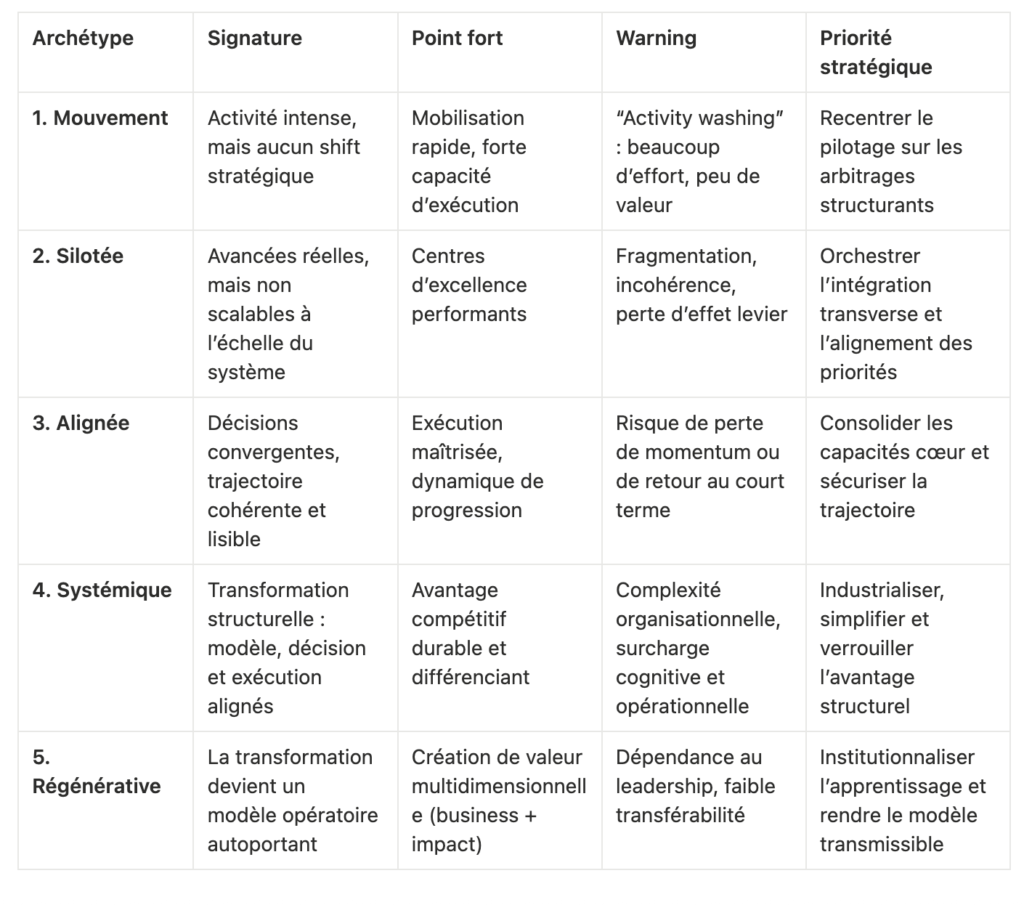
- 0-22 – Low maturity: “Company in motion” > Intense effort, low impact. Decisions and value unchanged.
- 23-40 – Intermediate maturity: “Siloed or modernized company” > Local progress, system unchanged.
- 41-54 – Advanced maturity: “Aligned company” > Coherence, structural shift, real transformation.
- 55-64 – High maturity: “Systemic or regenerative company” > Transformation integrated into the model. Rare, demanding and lasting.
The 5 archetypes of transformation
In an era of multiple shocks (geopolitical, climate and energy, societal and technological), the question is no longer just how to transform, but how far a company is willing to let its model evolve. Real transformation is rarely comfortable. It is demanding and often destabilizing. But it is also the only path that leads from mere adaptation to resilience, and from resilience to lasting value creation.
Between modernizing and transforming, the difference is not necessarily a matter of means or tools. It is a matter of awareness and decision. It plays out in how clear-eyed leadership teams are, in the clarity and courage of their trade-offs, and in their ability to decide in time, even as the external environment is already deep in transformation.

Malika Ait El Mouden explores how technologies, organizations and living systems can transform together. A digital transformation specialist with 18 years of experience in Europe, the Middle East and Southeast Asia, she has led international eCommerce and omnichannel programs. She has founded two companies, including a start-up that contributed to the development of circular solutions.
A board member of La French Tech and of the APM (Association pour le Progrès du Management), she also teaches in higher education and is following a program with MIT on the challenges of data and AI. She popularizes and spreads the concept of Twin Transformation.
Malika is the co-founder, with Julie Bonazzi, of Twin Transformation.fr