For the past fifteen years, digital transformation has been central to corporate strategy. At the same time, ecological issues have emerged as defining constraints, notably through the planetary boundaries framework proposed by Rockström and Steffen.
Yet these two dynamics have been steered separately: digital transformation toward performance and innovation, the ecological transition toward compliance and impact reduction. This separation is now being challenged by the joint evolution of technological, environmental and economic systems.
Twin transformation starts from an observation now widely shared in the scientific and strategic literature:
“digital and ecology do not describe two independent transformations, but two dimensions of a single systemic change.”
Digital technology is deeply restructuring how we produce, consume, move and govern. Ecological dynamics, for their part, remind us that these transformations take place in a material, finite and unstable world. Their convergence is not a normative choice, it is a strategic imperative.
The central question is therefore no longer whether these transformations should be undertaken, but under what conditions aligning them becomes necessary to preserve the competitiveness, resilience and sustainability of organizations.
1. Defining twin transformation
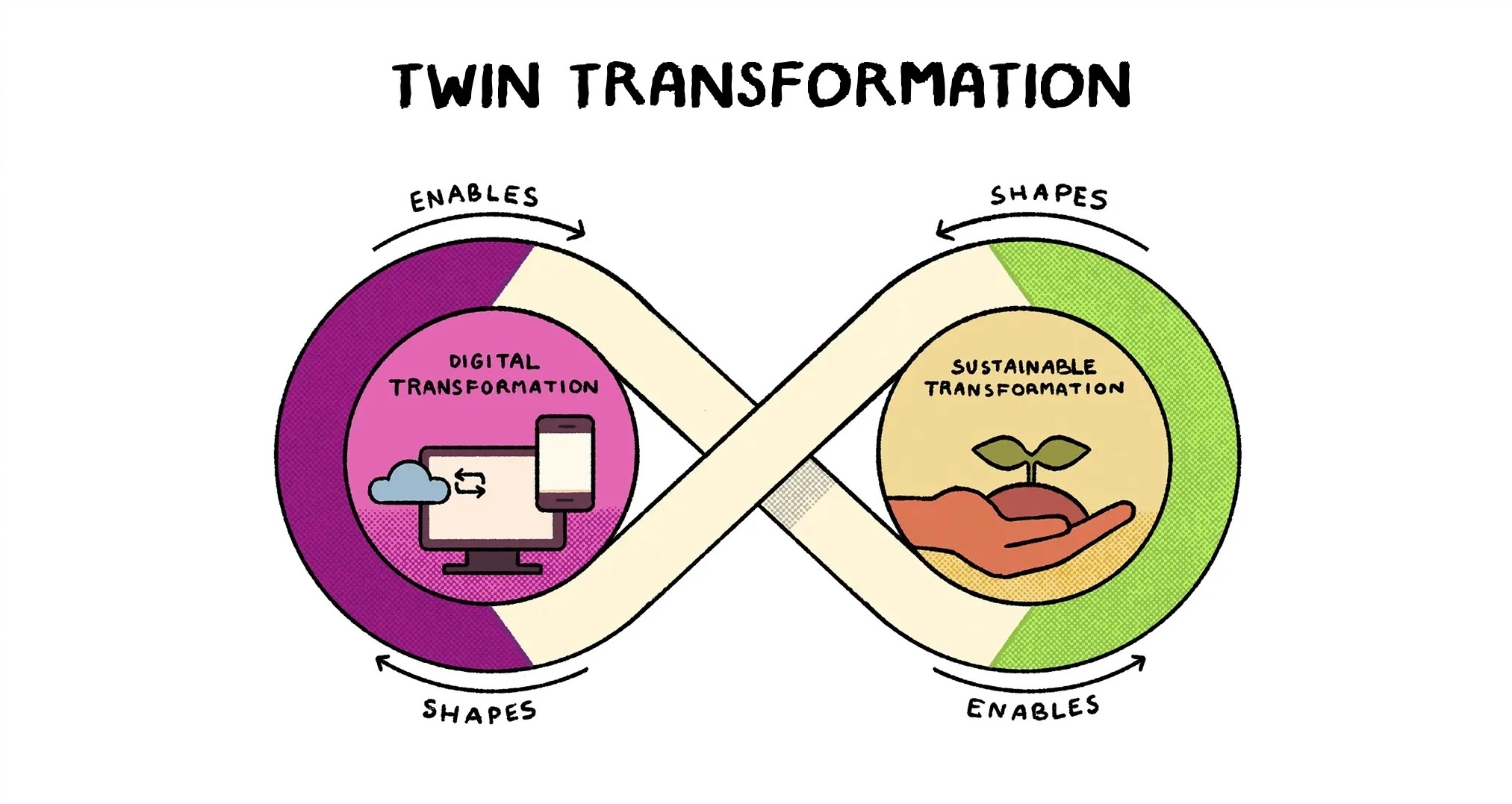
Twin transformation refers to the structured integration of two major transitions:
- digital transformation, based on data, connected infrastructure, automation, blockchain, the Internet of Things and AI;
- ecological transition, based on decarbonization, sobriety, circularity and sustainable resource management.
Unlike approaches that simply place these dynamics side by side, twin transformation holds that ecological transition depends on digital tools able to operate at scale, while digital transformation depends on stable ecological conditions.
This interdependence is documented:
Hilty and Aebischer show that digital technologies can reduce or increase environmental impacts depending on how they are designed and used.
In 2020, Sovacool demonstrated that digitalization drives a structural rise in energy and material demand.
Bratton reminds us that digital technology relies on physical infrastructure whose availability is neither infinite nor guaranteed.
Twin transformation does not follow on from earlier transformations. It emerges in a context the literature describes as an epochal shift, in which physical, technological and social dynamics stop being linear or predictable.
As Bonneuil, Fressoz and, more recently, Gauthier point out, this is a change of regime that alters the conditions of possibility for strategy, governance and technical progress.
2. Why this convergence is becoming unavoidable
Three major shifts are changing the conditions under which companies operate today.
2.1. Digital reveals its materiality
Bratton’s work (The Stack) shows that digital rests on a complex chain of infrastructure: data centers, networks, rare metals, semiconductors, energy. Digital is no longer an immaterial environment; it is subject to the same physical constraints as extractive or manufacturing industries.
2.2. Planetary boundaries directly affect performance
The literature on ecological systems (Rockström, Raworth, Dasgupta) stresses that linear models are physically reaching their limits. These dynamics already produce tangible effects:
- pressure on resources,
- rising logistics and energy costs,
- tighter regulation,
- operational disruption from climate hazards,
- heightened and amplified geopolitical risks and tensions
2.3. Risks become interconnected
Perrow and Taleb showed that tightly coupled systems generate systemic risks. Today:
- a cyberattack can halt production
- a climate event can disrupt several links in a supply chain
- a regulatory constraint can make a model built on intensive data use obsolete
Risk can no longer be approached sector by sector; it has become cross-cutting.
3. The implications of twin transformation
For leaders, twin transformation is an analytical framework rather than a program. It reorganizes four key dimensions.
3.1. Redefining performance
Building on Dasgupta, several studies stress the need to account for the value a company creates and destroys.
This means taking into account:
- digital performance
- total costs (energy, data, infrastructure)
- systemic risks
- environmental and regulatory impacts
“Performance is now multidimensional; EBITDA is no longer enough to assess the real value produced or destroyed.”
3.2. Evolving design logic
Research on the circular economy (MIT Center for Transportation & Logistics) shows the importance of designing systems compatible with:
- material durability
- energy efficiency
- circularity
- reduced externalities
Digital becomes both a design lever and a sustainability constraint.
3.3. Rethinking risk management
Twin transformation offers a framework for anticipating risks related to:
- climate
- cybersecurity
- data
- critical materials
- regulation
It makes it possible to factor in tail risks, rare but potentially decisive.
3.4. Evolving governance
Westerman and Bonnet’s work on digital transformation shows that governance is a decisive factor, and we have seen this firsthand in several organizations over the past few decades. Twin transformation requires de-siloed governance, bringing strategy, operations, M&S, IT, finance, procurement and CSR into a coherent decision-making process.
4. Necessity or illusion?
Twin transformation can look like an illusion if it remains a rhetorical framing:
- no empirical data
- superficial integration
- “transformation washing”-style communication
- recycling of existing initiatives
It becomes a necessity when it sheds light on three fundamental questions:
- Are digital investments compatible with physical and regulatory constraints in the medium term?
- Is the business model robust against combined risks?
- Is governance equipped to steer interdependent systems?
When the answers are uncertain, twin transformation becomes a minimal strategic framework rather than an optional concept.
The scientific literature and strategic analyses converge: digital and ecology no longer describe two parallel trajectories. They form a single system of constraints, opportunities and dependencies. In a world where risks, flows and infrastructure are interconnected, thinking about digital and ecology separately is less a strategic choice than an analytical error.
Twin transformation is neither a normative promise nor a speculative theory. It is a realistic reading of the conditions for action today and a framework for preparing organizations to operate effectively in the decade ahead.

Malika Ait El Mouden explores how technologies, organizations and living systems can transform together. A digital transformation specialist with 18 years of experience in Europe, the Middle East and Southeast Asia, she has led international eCommerce and omnichannel programs. She has founded two companies, including a start-up that contributed to the development of circular solutions.
A board member of La French Tech and of the APM (Association pour le Progrès du Management), she also teaches in higher education and is following a program with MIT on the challenges of data and AI. She popularizes and spreads the concept of Twin Transformation.
Malika is the co-founder, with Julie Bonazzi, of Twin Transformation.fr