How Mirega is turning a technology that came out of quantum research into a new way to measure methane emissions
Methane is invisible. Yet when it escapes from gas infrastructure, its impact on the climate is very real. That is the paradox of fugitive emissions: they can be both an economic loss for operators and a major climate issue, while remaining hard to detect and quantify accurately. And what you can’t measure well is inherently hard to manage.
This frontier between technology and environmental transformation is exactly where French start-up Mirega operates.
Its story is interesting because it doesn’t begin in the oil and gas industry. It begins in fundamental research, with technologies developed for quantum physics. A few years later, optical microcavities found a use in an entirely different field: measuring greenhouse gases.
It is a path that shows very concretely what Twin Transformation can look like: a technological innovation that doesn’t just improve an existing tool, but creates a new capability to understand and transform a system.
Methane: a climate problem, but also a measurement problem
Natural gas is mainly made up of methane. Its use as a fossil fuel has long been associated with lower CO₂ emissions than coal when burned. But the climate impact of natural gas doesn’t stop at combustion.
Between extraction and end use lies a complex chain: production, processing, transport, storage and distribution. At each of these stages, methane can be released into the atmosphere through leaks, equipment or venting operations. Methane is a particularly potent greenhouse gas. According to the IPCC, fossil methane has a global warming potential of 82.5 over 20 years and 29.8 over 100 years, relative to CO₂, which is set at 1. These indicators don’t describe exactly the same climate phenomenon, but they show how important methane is across different time scales.
So the question isn’t only how to reduce emissions. We first need to know where they are, in what quantities and how often they occur.
And that is where measurement becomes a strategic issue!
When the invisible becomes data
A methane leak doesn’t necessarily look like an easily identifiable plume. Emissions can be small, intermittent or spread across infrastructure that stretches over long distances. For an industrial operator, identifying a leak is therefore not always enough. Operators need to detect it, quantify it, then verify that the repair actually reduced emissions. Measurement is now also a regulatory matter.
The European Union has adopted its first regulation dedicated to reducing methane emissions in the energy sector. Regulation (EU) 2024/1787 entered into force on August 4, 2024 and, among other things, tightens requirements for measuring, monitoring, reporting and verifying emissions, as well as obligations to detect and repair leaks.
The European Commission itself stresses that, in the energy sector, one of the main challenges is first to detect and quantify emissions. One aim is to move gradually from estimates to direct, verifiable measurements.
The technological need is therefore very concrete: making what was hard to observe measurable.
Measuring more so we can act
The stakes go well beyond regulatory compliance. According to the International Energy Agency, methane emissions from the fossil fuel sector are one of the fastest and cheapest opportunities to reduce greenhouse gas emissions. The IEA estimates that around 70% of methane emissions from the fossil fuel sector could be cut with existing technologies. In oil and gas, it estimates that emissions could be reduced by about 75% through known measures, notably leak detection and repair programs.
But you still need to know where to act!
The IEA also points to an underlying problem: a large share of methane emissions is still poorly backed by direct measurements. When emissions are actually measured, the resulting estimates are often higher than reported figures.
In other words, the quality of action also depends on the quality of the information available.
This is where Mirega comes in.
Mirega: bringing measurement to the field
Founded in 2022 by Vincent Hardy and his team, building on their research, Mirega develops miniaturized gas analyzers designed, among other things, to measure low concentrations of greenhouse gases.
The aim is to make precise measurement possible in situations where mobility is essential.
Mirega describes its analyzer as 100 times smaller than existing solutions. The Atom Chips group at the Laboratoire Kastler Brossel, meanwhile, describes a device that can weigh less than a tenth and take up a hundredth of the volume of existing instruments, with an architecture compact enough to be integrated into a handheld device or mounted on a drone. This difference in size is not just an engineering achievement. It can change the way we measure.
A smaller, lighter instrument can be carried into the field, brought closer to infrastructure, integrated into other systems and potentially deployed more often.
Miniaturization doesn’t just make the instrument smaller. It can make measurement more accessible.
And that is where the technology starts to change the system around it.
A quantum technology switches fields
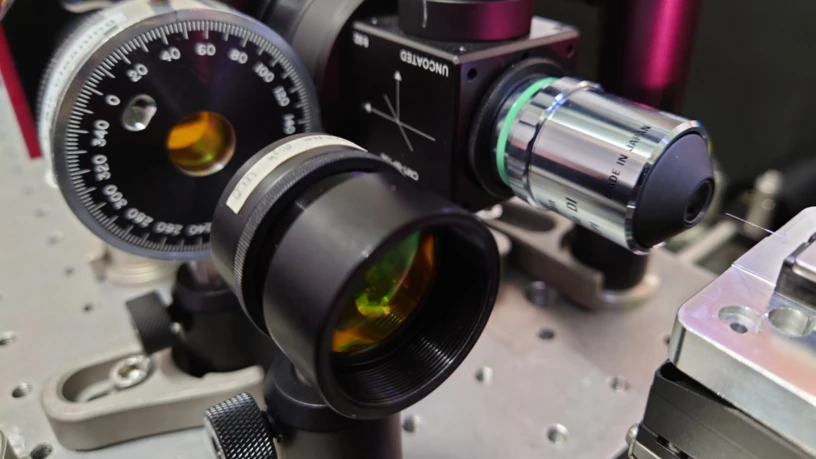
The origin of the technology developed by Mirega is particularly telling. Researchers at the Laboratoire Kastler Brossel and the Atom Chips group have been working for several years on fiber Fabry-Pérot microcavities. These devices were developed largely as part of research into quantum technologies.
A Fabry-Pérot cavity is an optical resonator made of two reflective surfaces facing each other. In the technology developed by the team, the mirrors are built into the ends of optical fibers, creating an extremely compact cavity. The technology thus combines the optical properties of a high-finesse cavity with the compactness and robustness of a fiber-based architecture.
This combination opened the door to a new application: trace gas analysis.
A 2024 publication co-authored by Jakob Reichel, Romain Long, Pierre Mahiou and Vincent Hardy, among others, describes exactly this shift. The authors explain that fiber Fabry-Pérot cavities, initially developed for quantum technology research, are now being used to develop mobile greenhouse gas analyzers.
This may be one of the most interesting lessons from Mirega’s story. Innovation rarely follows a linear path.
A technology designed to answer a fundamental research question can find new relevance when it meets an environmental or industrial problem.
From microcavity to portable analyzer
The MiTra project, led by the Atom Chips group in collaboration with Mirega, is pursuing exactly this transformation: using fiber Fabry-Pérot microcavities to build a compact, portable and robust gas analyzer. The prototype relies on a cavity whose analysis volume is under one microliter. The device is designed to retain the performance of cavity laser spectroscopy while drastically reducing the bulk of traditional instruments. The project also received ERC Proof of Concept funding to help bring the technology closer to market.
After all, innovation isn’t only about improving the precision of a device installed in a lab. It is about making this measurement capability available in environments where it has so far been harder to deploy.
From pipeline to drone
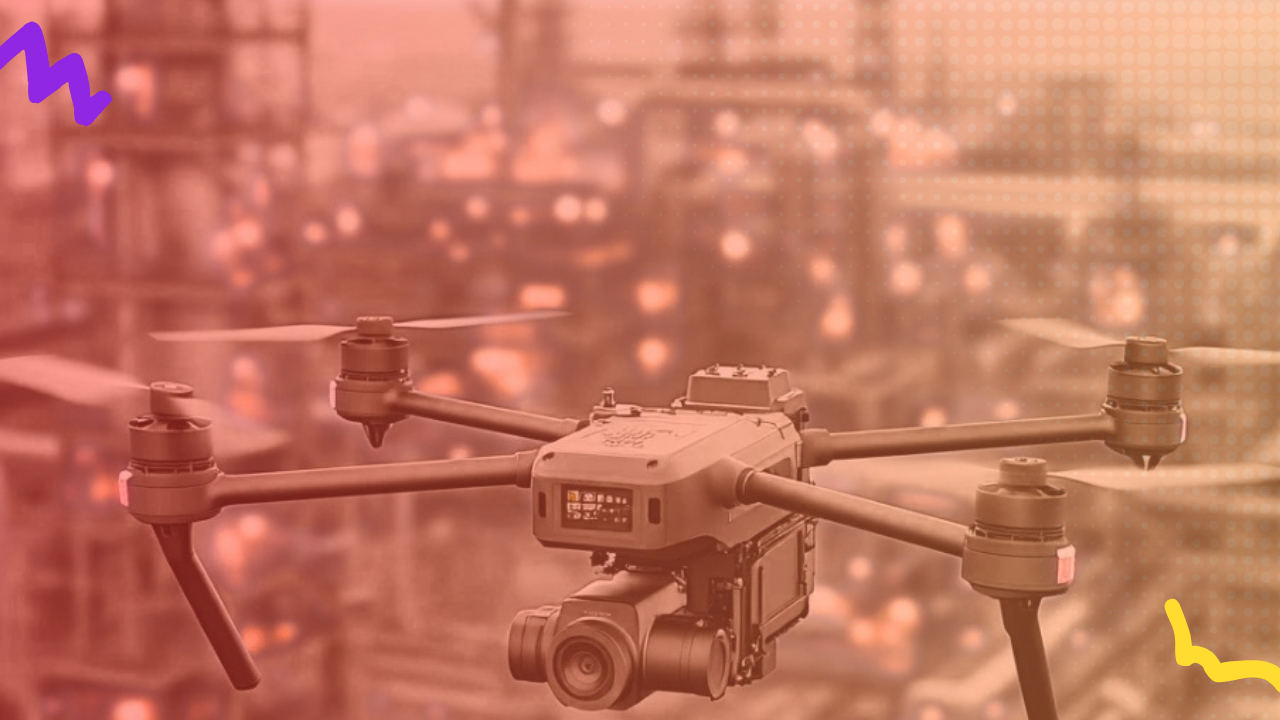
This new mobility opens up several scenarios. On gas infrastructure, a portable analyzer could support monitoring and inspection operations. On hard-to-reach sites, the technology could be carried on a drone. The drone is only one example, though. The real change lies elsewhere: measurement is no longer necessarily tied to a fixed location. It becomes mobile, targeted and potentially repeated.
This points to new monitoring strategies: going to the infrastructure rather than bringing the infrastructure to the instrument; adding more measurement points; going back after an intervention; comparing data before and after repair.
The technology then does more than improve measurement. It can help transform the operational process itself.
Beyond methane
Methane is a particularly obvious application, but the technology could be of interest to other sectors.
The work on microcavities more broadly targets the detection and analysis of greenhouse gases. The Atom Chips group notably cites CO₂ among the gases already covered by the project’s demonstrations. Potential applications could also extend to waste, where methane is produced by the decomposition of organic matter, as well as other industrial or environmental sectors that require measuring low-concentration gases.
But one important distinction remains: being able to measure does not, in itself, reduce emissions. It creates an additional capacity to make decisions, and that nuance is essential.
Data as the infrastructure of the transition
This is where the Mirega case becomes a genuine Twin Transformation story.
Environmental transformation needs technologies able to measure, anticipate and steer. But technology itself is evolving under the pressure of new environmental challenges: it must become leaner, more compact, more mobile, more accessible and better suited to real-world conditions. The two transformations feed and shape each other.
A higher-performing technology is not necessarily a transformative one. It becomes so when it changes what organizations are able to see, understand or do.
Making the invisible actionable
Mirega’s story begins with a very concrete climate problem: methane emissions that are hard to observe. It continues with a technology born from fundamental research in quantum physics.
And it leads to a much broader question: what happens when a technology makes it possible to measure a phenomenon that was previously hard to access? The answer isn’t limited to methane. Better measurement makes it possible to identify an emission source, prioritize an intervention, verify its effectiveness and document the progress made.
It also lets an organization change the scale at which it observes its environment. That may be where the real value of Twin Transformation lies.
It isn’t about adding an environmental layer to a technological innovation. It is about making sure that technological innovation increases our capacity to transform the systems our environment depends on.
In Mirega’s case, everything starts with an optical microcavity, but the ultimate stakes are much bigger: turning the invisible into information, information into decisions and decisions into action.
Because to reduce what we can’t see, we first have to be able to measure it.

Vincent Hardy explores the links between technology, measurement and the environmental transition. A graduate engineer of Centrale Marseille in physics and optics, an entrepreneur and an executive, he has worked for more than twenty years at the intersection of technological innovation, industry and international development. He founded Sinoptix, which specialized in optical components between Europe and China, then supported the growth of ALPAO, a pioneering company in adaptive optics.
Founder and head of Mirega, he is now interested in technologies that can make environmental challenges more measurable and more actionable. Mirega develops miniaturized gas analyzers that precisely measure very low concentrations, notably of CO₂. Through his public speaking, Vincent defends a pragmatic approach to the transition: measure better to understand, decide and act better.